
DGT test · 1,397 questions
Traffic signs, markings and signals · Page 14 of 28
Road signs, road markings, traffic lights, police signals and temporary markings: what they mean and which one wins when they disagree. The topic with the most questions in the bank.
Questions in this topic, with answers
1,397 questions, 50 per page, with the correct answer and the explanation. Page 14 of 28.
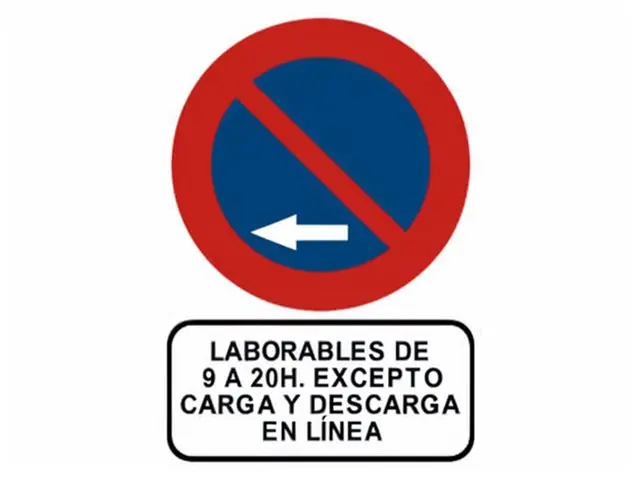
Al ver esta señal, un miércoles a las 12 del mediodía, un turismo ...
On seeing this sign on a Wednesday at 12 noon, a car...
- Asolo puede estacionar para dejar un paquete.may only park to drop off a parcel.
- Bpuede parar.may stop.
- Cno puede parar ni estacionar.may neither stop nor park.
ExplanationThe sign prohibits parking on that side of the carriageway on working days from 9:00 to 20:00, except for loading and unloading parallel to the kerb. On a Wednesday at 12:00 the ban applies, but the sign does not prohibit stopping, so the car may stop.
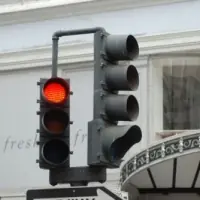
Qué tipos de semáforos existen según el Reglamento de circulación?
What types of traffic lights are there under the Traffic Regulations?
- AÚnicamente para vehículosOnly for vehicles.
- BÚnicamente para peatonesOnly for pedestrians.
- CPara peatones y para vehículosFor pedestrians and for vehicles.
ExplanationThere are two types of traffic lights: for pedestrians and for vehicles. Traffic lights for vehicles include circular lights, square (lane) lights and lights reserved for certain vehicles.
¿Le está permitido estacionar su turismo a la derecha de la calzada teniendo en cuenta que hay una línea amarilla discontinua pintada junto al bordillo?
Are you allowed to park your car on the right of the carriageway, given that there is a broken yellow line painted next to the kerb?
- ASí.Yes.
- BNo, porque lo prohíbe la línea pintada junto al bordillo.No, because the line painted next to the kerb prohibits it.
- CNo, porque circulo por una vía preferente.No, because I am driving on a priority road.
ExplanationA broken yellow line painted next to the kerb prohibits parking in that area. So you cannot park there, which is why this answer is correct.
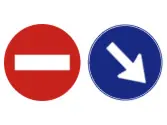
Según las señales, ¿en la próxima intersección podremos cambiar de dirección a la izquierda?
According to the signs, may you turn left at the next junction?
- ASí.Yes.
- BNo, salvo que un agente lo autorice.No, unless a traffic officer allows it.
- CNo.No.
ExplanationThis is a mandatory passage sign: it shows where vehicles must pass. It allows you to turn. Mandatory direction signs, on the other hand, set the direction of travel and therefore only allow you to do what the arrow shows.
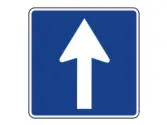
¿Podremos cambiar de dirección a partir de la señal?
May we turn after this sign?
- ASí.Yes.
- BNo.No.
- CNo, solo permite seguir de frente.No, it only allows going straight ahead.
ExplanationThe sign in the question shows that vehicles must travel in the direction of the arrow and that travelling in the opposite direction is prohibited. This sign does not prohibit turning, but it does prohibit U-turns. Do not confuse it with the round «Compulsory direction» sign, which shows the direction that vehicles must follow.
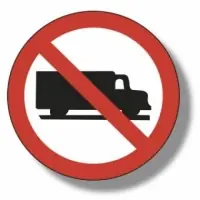
¿De qué color serán los símbolos que aparecen en las señales de reglamentación iluminadas?
What colour are the symbols on illuminated regulatory signs?
- AVioletaViolet
- BRojoRed
- CBlancoWhite
ExplanationWhen regulatory signs are illuminated, their symbols appear lit up in white on a dark, unlit background.
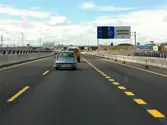
Las marcas viales que señalizan un tramo de obras...
Road markings that mark a stretch of roadworks...
- Asignifican lo mismo que las que se utilizan cuando no hay obras.mean the same as the ones used when there are no roadworks.
- Bsolamente alertan sobre la necesidad de extremar la precaución.only warn that you must take extra care.
- Csolamente hay que respetarlas cuando hay personas trabajando.only have to be obeyed when people are working.
ExplanationRoadworks markings have the same meaning as the equivalent ones used when there are no roadworks, although they are yellow.
Ves una señal circular de fondo azul con la silueta blanca de una bicicleta y otra circular de fondo blanco y borde rojo con una bicicleta negra. ¿En qué se diferencian?
You see a round sign with a blue background and a white bicycle, and another round sign with a white background, a red border and a black bicycle. What is the difference between them?
- ALa azul obliga a circular por la vía ciclista; la de borde rojo prohíbe la entrada a bicicletasThe blue one requires you to use the cycle route; the one with a red border prohibits entry to bicycles
- BAmbas prohíben las bicicletas, solo cambia el colorBoth prohibit bicycles; only the colour is different
- CLa azul es de peligro y la roja de obligaciónThe blue one is a danger sign and the red one is a mandatory sign
ExplanationThe blue one is R-407a, road reserved for cycles, use compulsory: it requires cyclists to use it and prohibits other road users from using it. The one with the red border is R-114, no entry for cycles: it prohibits access to bicycles.
¿Podemos atravesar unas señales de balizamiento luminosas?
May we cross a line of lighted marker beacons?
- ASí, si la luz es intermitente.Yes, if the light is flashing.
- BNo, si la luz es fija.No, if the light is steady.
- CNo, no podemos atravesar la línea imaginaria, tanto si es fija como intermitente.No, we may not cross the imaginary line, whether the light is steady or flashing.
ExplanationYellow marker lights, whether steady or flashing, prohibit crossing the imaginary line that joins them.
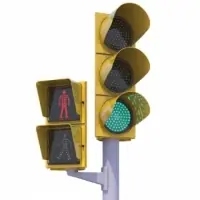
La luz verde de un semáforo circular para vehículos significa que…
A green light on a circular traffic light for vehicles means that…
- ANo puede pasar hasta que no se apague.You may not go until it goes out.
- BPuede pasar y tiene preferencia de paso.You may go and you have priority.
- CDebe dejar pasar al resto de vehículos.You must let all other vehicles go first.
ExplanationA green light on a circular traffic light allows you to go and gives you priority over vehicles that have a red light. Even so, when turning you must respect pedestrians who are crossing, and you must not enter the junction if you expect to end up stopped inside it.
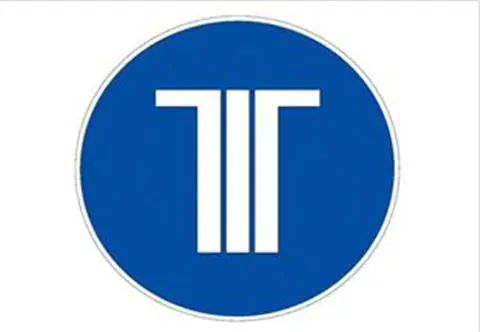
Esta señal situada sobre un carril en un puesto de peaje indica que sólo se puede pagar...
This sign above a lane at a toll station means that you can only pay...
- Aen metálico.in cash.
- Bcon tarjeta de crédito.by credit card.
- Cmediante el sistema de peaje dinámico o telepeaje.using the dynamic toll or electronic toll system.
ExplanationThe round blue sign with the letter T above a toll lane means that the lane is reserved for payment by electronic toll or dynamic toll, without stopping. In the square version, the lane also accepts other forms of payment.
¿Qué es una detención en la circulación?
What is a halt (detención) in traffic?
- AQue el vehículo quede inmóvil por necesidades de la circulación.When the vehicle is brought to a standstill because of traffic needs.
- BDetenerse por cualquier motivo.Stopping for any reason.
- CEstacionar sin bajarse del vehículo.Parking without getting out of the vehicle.
ExplanationIn the RGC, a halt (detención) means bringing the vehicle to a standstill because of traffic needs, such as giving way at a stop sign or a traffic light. It differs from an ordinary stop (parada) or from parking, because it involves an obligation to stop at a signal and wait until it is safe to move off again. The correct answer refers to situations where stopping is compulsory, which are covered by the rules on stop signals and on respecting other vehicles' priority, as shown by the continuous transverse line (M-4.1).
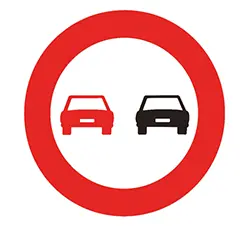
Esta señal, ¿permite realizar la maniobra de adelantamiento?
Does this sign allow overtaking?
- ANo, en ningún caso.No, under no circumstances.
- BNo, salvo que se adelante a un turismo.No, unless you are overtaking a car.
- CSolo si la maniobra no implica invadir el sentido contrario.Only if the manoeuvre does not involve entering the opposite side of the road.
ExplanationSign R-305 prohibits overtaking motor vehicles when the manoeuvre involves entering the part of the road reserved for oncoming traffic. If the overtaking can be done without entering it, the sign does not prohibit it.
En una calzada con dos sentidos de circulación y tres carriles separados por líneas discontinuas, ¿podrá un conjunto de 7 metros de longitud circular por el carril situado más a su izquierda?
On a two-way carriageway with three lanes separated by broken lines, may a vehicle combination 7 metres long drive in the lane furthest to its left?
- ASí, para cambiar de dirección a la izquierda.Yes, to turn left.
- BNo, circulará por el carril derecho y usará el central solo para adelantar o girar a la izquierda.No, it will drive in the right-hand lane and use the centre lane only to overtake or turn left.
- CSí, si es el que conviene a su destino.Yes, if it is the lane that suits its destination.
ExplanationUnder Article 30.1.b of the General Traffic Regulations (RGC), on a two-way carriageway with three lanes separated by broken lines, you drive in the right-hand lane and never in the lane furthest to the left. The centre lane is only used for overtaking and turning left.
Un semáforo en verde:
A green traffic light:
- AObliga a pasar aunque haya un obstáculo.Requires you to go even if there is an obstacle.
- BPermite el paso siempre que no se obstruya la circulación al otro lado.Allows you to go as long as you do not obstruct traffic on the other side.
- CSignifica parada obligatoria.Means you must stop.
ExplanationGreen allows you to go ahead, but you must not enter the junction if you are going to get stuck in it.
¿Qué indica una línea longitudinal ancha y discontinua?
What does a wide broken longitudinal line indicate?
- AIndica que hay un carril especial.It indicates a special lane.
- BIndica la proximidad de una línea continua.It indicates that a solid line is coming up.
- CIndica que hay un carril reversible.It indicates a reversible lane.
ExplanationA wide broken longitudinal line indicates a special lane for certain types of vehicle, such as buses or taxis. Under the General Traffic Regulations, these markings mark out lanes to make driving and manoeuvring easier for the vehicles allowed to use them. Because other vehicles may cross this line in suitable circumstances, traffic flows more efficiently and in a more orderly way, without getting in the way of the vehicles using the special lane.
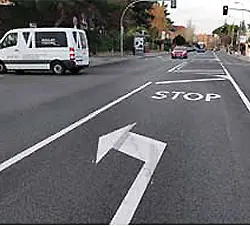
En esta intersección con señal de STOP y buena visibilidad, ¿qué debe hacer?
At this junction with a STOP sign and good visibility, what must you do?
- ADetenerse siempre una vez superada la línea transversal.Always stop after passing the transverse line.
- BSeguir circulando sin detenerse, porque no viene ningún vehículo de frente.Carry on without stopping, because no vehicle is coming towards you.
- CDetenerse siempre ante la línea transversal.Always stop at the transverse line.
ExplanationA STOP sign always requires you to stop at the stop line, even if visibility is good and nobody is coming; then you give way to whoever has priority.
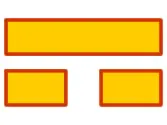
Esta señal nos indica que el vehículo o conjunto de vehículos tiene una longitud...
This sign tells us that the vehicle or combination of vehicles is...
- ASuperior a 12 metros.More than 12 metres long.
- BInferior a 12 metros.Less than 12 metres long.
- CDe 7 metros.7 metres long.
ExplanationThe long vehicle plate indicates that the vehicle or combination of vehicles is more than 12 metres long.
En un semáforo en verde para usted, pero con la salida bloqueada por una retención al otro lado del cruce:
The traffic light is green for you, but the way out is blocked by a queue on the other side of the junction:
- ANo debe entrar en el cruce hasta poder salir de él.You must not enter the junction until you can get out of it.
- BDebe entrar porque tiene el verde.You must enter because you have a green light.
- CDebe tocar el claxon y avanzar.You must sound the horn and move forward.
ExplanationEven if the light is green, you must not enter the junction if you are going to end up stopped inside it, blocking it.
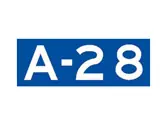
¿Qué tipo de vía identifica esta señal?
What type of road does this sign identify?
- AIdentifica una autopista.It identifies an autopista (motorway).
- BIdentifica una autovía.It identifies an autovía (dual carriageway).
- CIdentifica una autopista o autovía.It identifies an autopista (motorway) or an autovía (dual carriageway).
ExplanationThis sign identifies an autopista or autovía. When the sign identifies a toll autopista, it will contain the letters AP.
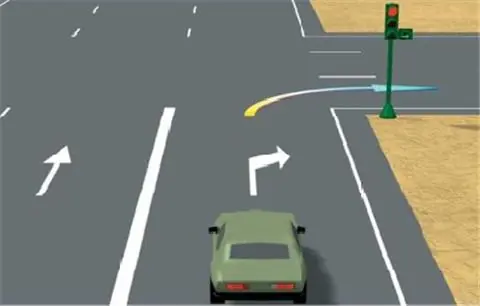
¿Qué indica la flecha verde del semáforo?
What does the green arrow on the traffic light indicate?
- AQue debo tomar la dirección que indica la flecha, con precaución y dejando pasar a los vehículos que circulen por el carril al que me incorporo.That I may go in the direction shown by the arrow, with care and letting vehicles in the lane I am joining go first.
- BQue puedo girar a la derecha cuando se enciende la luz verde del semáforo principal.That I may turn right when the green light of the main traffic light comes on.
- CQue puedo girar a la derecha con prioridad.That I may turn right with priority.
ExplanationA green arrow on a traffic light allows you to go in the direction shown even if the main light is red, but it does not give you priority. You must do it with care, giving way to vehicles in the lane you are joining and to pedestrians.
Si sobre el carril por el que Ud. circula hay un semáforo cuadrado en el que se enciende una luz roja en forma de aspa, Ud. debe...
If there is a square traffic light over the lane you are driving in and a red X-shaped light comes on, you must...
- ADetenerse a su altura.Stop level with it.
- BAbandonarlo en el tiempo más breve posible.Leave the lane as quickly as possible.
- CDetenerse en la próxima intersección.Stop at the next junction.
ExplanationLeaving the lane as quickly as possible is the correct answer. The red X-shaped light means that the lane is closed and you must leave it safely and quickly, to avoid obstructions and keep traffic flowing.
Ud. circula conduciendo su turismo a 90 kilómetros por hora con la línea longitudinal continua de borde de calzada entre las ruedas. ¿Es correcto su comportamiento?
You are driving your car at 90 kilometres per hour with the continuous edge line of the carriageway between your wheels. Is this behaviour correct?
- ANo.No.
- BSí, si no circula nadie por el arcén.Yes, if nobody is using the hard shoulder.
- CSí.Yes.
ExplanationA car driver must drive on the carriageway and not on the hard shoulder, except for emergency reasons (Article 30 of the General Traffic Regulations). Having the edge line between your wheels means driving partly on the hard shoulder when there is no emergency.
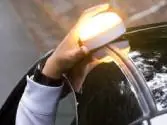
La señal V-16, de preseñalización de peligro, es de color...
The V-16 hazard warning device (flashing warning beacon) is coloured...
- ABlanco y rojo.White and red.
- BAmarillo y rojo.Yellow and red.
- CAmarillo auto.Auto yellow (amber).
ExplanationAccording to Annex XI of the General Vehicle Regulations, the V-16 sign, the hazard warning device, is auto yellow (amber) and is placed on the highest possible part of the immobilised vehicle. V-2 is a different sign: vehicle-obstacle on the road.
Una marca amarilla en zig-zag...
A yellow zigzag marking...
- Aprohíbe el estacionamiento.prohibits parking.
- Bprohíbe la parada.prohibits stopping.
- Cprohíbe la parada y el estacionamiento.prohibits stopping and parking.
ExplanationA yellow zigzag marking prohibits parking but allows stopping.
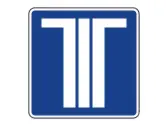
Esta señal situada sobre un carril de un puesto de peaje indica que en él...
This sign, placed over a lane at a toll station, indicates that in that lane...
- Asólo se puede abonar el peaje mediante tarjeta.the toll can only be paid by card.
- Bes obligatorio el pago del peaje mediante el sistema de peaje dinámico o telepeaje.the toll must be paid using the dynamic toll or electronic toll system.
- Cse puede pagar mediante el sistema de peaje dinámico o telepeaje.you can pay using the dynamic toll or electronic toll system.
ExplanationThe sign in the question indicates that vehicles using a lane signed in this way may pay with the electronic toll system, but they do not have to; they may also use other payment methods. Do not confuse it with the same sign in round form, which requires payment exclusively with the electronic toll system.
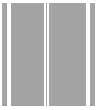
¿Qué significado tiene una marca vial constituida por dos líneas continuas?
What does a road marking made up of two continuous lines mean?
- ADelimita el carril reversible.It marks out the reversible lane.
- BTiene el mismo significado que una línea continua.It has the same meaning as a continuous line.
- CDelimita los bordes de la calzada, separando ésta del arcén.It marks the edges of the carriageway, separating it from the hard shoulder.
ExplanationA marking formed by two parallel continuous lines has the same meaning as a single continuous line: it must not be crossed or driven on. A reversible lane is marked out with double broken lines.
El carril por el que Ud. circula está separado del resto de los carriles por una línea discontinua en la que las marcas son sensiblemente más anchas que en el caso general; por tanto, debe saber que circula por...
The lane you are driving in is separated from the other lanes by a broken line whose dashes are noticeably wider than usual; so you should know that you are driving in...
- AUn carril normal de circulación, sin ningún uso particular.A normal traffic lane, with no special use.
- BUn carril especial.A special lane.
- CUn carril reversible.A reversible lane.
ExplanationAccording to the catalogue of road markings in Annex I of the General Traffic Regulations (RGC), the wide broken line (M-1.6 and M-1.7) separates a special lane from the basic lanes: a speed-change lane (acceleration or deceleration lane), a weaving lane, a lane reserved for certain vehicles or an additional lane for slow vehicles. A reversible lane is marked with double broken lines.
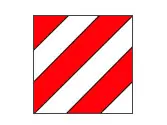
¿En qué situación se debe utilizar la señal V-20,cargas que sobresalen, en los vehículos?
When must sign V-20 (projecting load) be used on vehicles?
- ACuando la carga sobresale por detrás de un turismo.When the load sticks out from the back of a car.
- BCuando la carga sobresale por delante y por detrás de un camión.When the load sticks out from the front and the back of a lorry.
- CEn todos los vehículos cuando su carga es indivisible.On all vehicles whose load is indivisible.
ExplanationWhenever the load sticks out from the back of the vehicle, except on vehicles less than 1 metre wide, it must be marked with a panel (V-20) measuring 50 by 50 centimetres, painted with alternating red and white diagonal stripes. The panel must be placed at the rear end of the load so that it stays perpendicular to the vehicle's axis at all times.
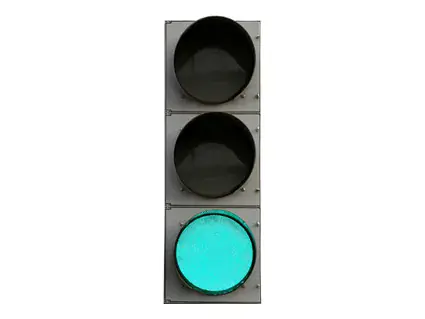
En una intersección, ¿qué indica la luz verde iluminada en un semáforo circular?
At a junction, what does a lit green light on a circular traffic light indicate?
- AQue está permitido pasar, pero cediendo el paso a los vehículos que se acerquen por la vía transversal.That you may go, but giving way to vehicles approaching on the crossing road.
- BQue está permitido el paso con prioridad.That you may go with priority.
- CQue se debe extremar la precaución.That you must take extreme care.
ExplanationA lit green light on a circular traffic light means that you may go with priority. This means that drivers may go ahead without having to give way to vehicles approaching on the crossing road.
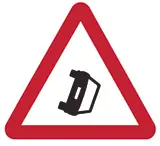
¿De qué peligro nos advierte esta señal?
What danger does this sign warn us of?
- AObstrucción en la calzada.An obstruction on the carriageway.
- BEscalón lateral.A drop at the edge of the road.
- CPavimento deslizante.A slippery road surface.
ExplanationThe sign in the picture, showing an overturned vehicle, warns that you are approaching a place where the carriageway is obstructed, for example by an accident or a breakdown. You must reduce speed and be ready to stop or go round the obstacle.
En caso de encontrar un semáforo amarillo intermitente junto a una señal de stop, ¿qué haremos?
If you find a flashing amber traffic light next to a STOP sign, what will you do?
- ADetenerse solo si vienen vehículos por la derecha.Stop only if vehicles are coming from the right.
- BPasar con precaución cediendo el paso.Go through with caution, giving way.
- CRespetar el stop y detenerse.Obey the STOP sign and stop.
ExplanationIn this case of signs that contradict each other, we will obey the STOP sign and stop before the junction.
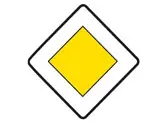
¿Qué le indica la señal de la imagen?
What does the sign in the picture tell you?
- AVía pública calificada de atención preferente.Public road classed as requiring priority attention.
- BPrioridad de paso a los vehículos que se acerquen por la derecha.Right of way for vehicles approaching from the right.
- CCalzada con prioridad de paso en las intersecciones.Carriageway with right of way at junctions.
ExplanationThe sign in the question tells drivers of vehicles on a carriageway that they have priority at junctions over vehicles on another carriageway.
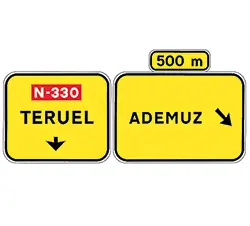
Cuando el fondo de las señales de orientación es amarillo, indica que se circula por...
When direction signs have a yellow background, it means you are travelling on...
- Aun tramo de vía en obras.a stretch of road with roadworks.
- Buna vía para automóviles.a road reserved for motor cars.
- Cun tramo de vía especialmente peligroso.a particularly dangerous stretch of road.
ExplanationA yellow background on direction signs identifies temporary roadworks signs, which temporarily replace the usual signs on that stretch.
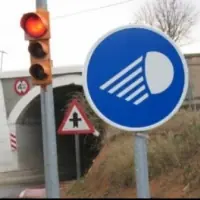
¿En qué lugar se encuentra a menudo la señal de obligación de alumbrado de corto alcance?
Where is the mandatory dipped-headlights sign often found?
- AA la entrada de un tunelAt the entrance to a tunnel
- BEn zonas próximas a colegios y hospitalesIn areas near schools and hospitals
- CEn carreteras sinuosasOn winding roads
ExplanationThe mandatory dipped-headlights sign is usually placed at tunnel entrances, where you must switch on at least the dipped headlights at any time of day. It indicates that from that point onwards they must be kept on.
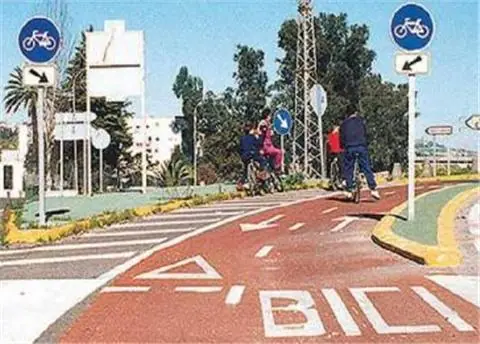
¿Qué indica la señal circular azul?
What does the round blue sign indicate?
- APermite circular a bicicletas y ciclomotores.It allows bicycles and mopeds.
- BPermite circular a bicicletas solamente.It allows bicycles only.
- CPermite circular a vehículos de dos ruedas.It allows two-wheeled vehicles.
ExplanationThe round blue sign with a bicycle indicates a road reserved for bicycles: cyclists must use it and other vehicles may not. The road reserved for mopeds has a different sign, showing a moped.
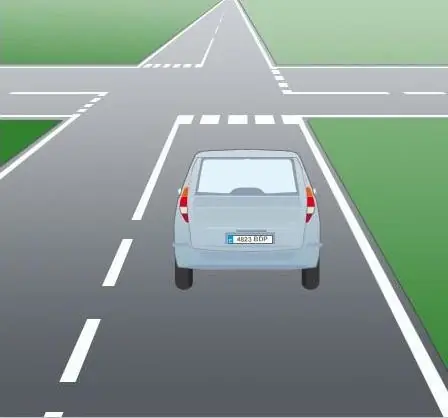
Un conductor que llega a una intersección en la que sólo hay una marca transversal discontinua…
A driver reaching a junction where there is only a broken transverse marking…
- ANo debe franquear esa marca en ningún caso.Must not cross that marking under any circumstances.
- BDebe detenerse obligatoriamente en la intersección.Must stop at the junction.
- CNo debe rebasarla si tiene que ceder el paso por aplicación de las normas de prioridad.Must not go past it if they have to give way under the right-of-way rules.
ExplanationA broken transverse marking shows where you must stop if you have to give way, because of a give-way sign or the right-of-way rules. It does not always require you to stop: if you do not have to give way to anyone, you may continue.
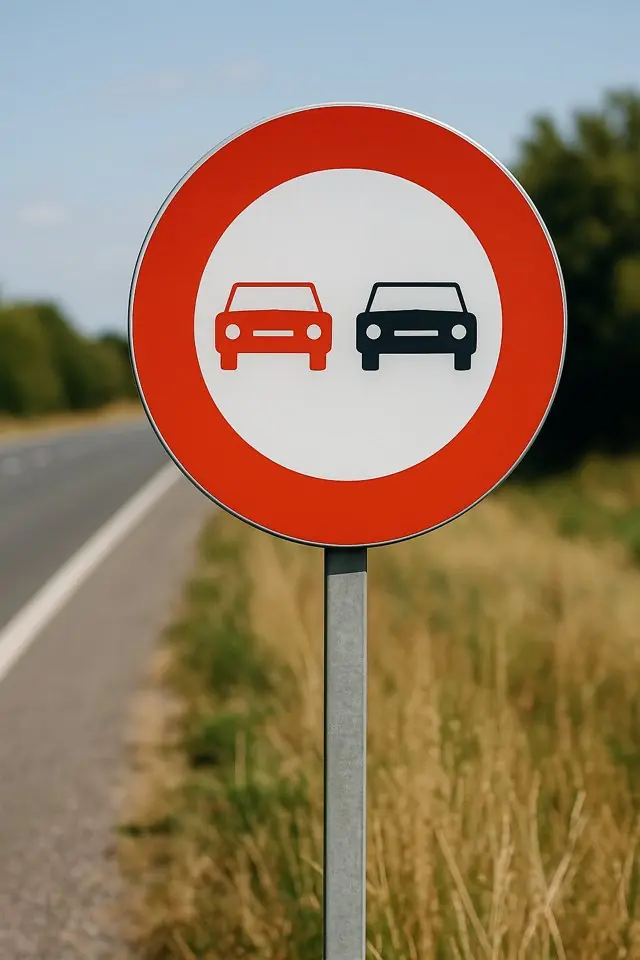
¿Esta señal permite adelantar a un vehículo de motor?
Does this sign allow you to overtake a motor vehicle?
- ANo, salvo que pueda adelantar sin invadir la zona reservada al sentido contrario.No, unless you can overtake without moving into the area for the opposite direction.
- BNo, en ningún caso.No, under no circumstances.
- CNo, salvo si se adelanta a un turismo.No, unless you are overtaking a car.
ExplanationSign R-305 prohibits overtaking motor vehicles when the manoeuvre involves moving into the area for the opposite direction. If you can overtake without doing so, for example a two-wheeled motorcycle in a wide lane, the sign does not prohibit it.
Un semáforo con una línea blanca sobre fondo negro: ¿a qué vehículos se aplica?
A traffic light with a white line on a black background: which vehicles does it apply to?
- AA tranvías y autobuses.Trams and buses.
- BA bicicletas y ciclomotores.Bicycles and mopeds.
- CA todos los vehículos.All vehicles.
ExplanationUnder Annex I of the RGC (section 4.4), a traffic light with a lit white bar on a round black background applies only to trams and regular-service buses, unless there is a reserved lane, in which case it applies to those using that lane.
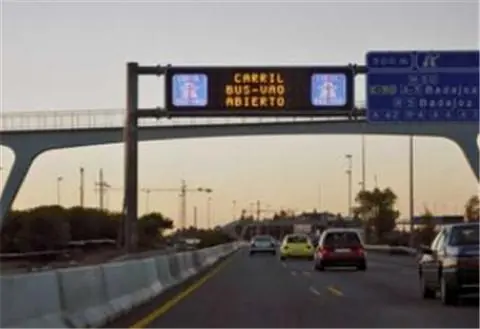
Cuando sólo lo ocupe su conductor, ¿puede un turismo circular por un carril para VAO?
When only the driver is in it, may a car use an HOV lane (VAO)?
- ASí, siempre que sea un vehículo no prioritario en servicio de urgencia.Yes, provided it is a non-priority vehicle on an emergency call.
- BSí, si el vehículo lleva la señal de minusválido.Yes, if the vehicle displays the disabled person sign.
- CNo, nunca.No, never.
ExplanationUnder Article 35 of the RGC, a car with only the driver on board may use the HOV (VAO) lane if it displays sign V-15, for a vehicle carrying a person with a disability, or the corresponding parking card. Otherwise, it needs the minimum occupancy set.
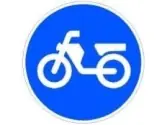
Si se encuentra esta señal a la entrada de una vía debe saber que...
If you find this sign at the entrance to a road, you should know that...
- AEs una vía reservada para ciclos y ciclomotores.It is a road reserved for cycles and mopeds.
- BLa utilización de esta vía está prohibida a todos los usuarios que no sean conductores de ciclomotores.Use of this road is prohibited for all users who are not moped riders.
- CLa circulación de ciclomotores por esta vía está prohibida.Mopeds are prohibited on this road.
ExplanationThe sign in the question means that moped riders must use the road at whose entrance it stands, and that all other road users are prohibited from using it.
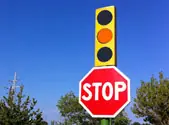
Si nos encontramos un semáforo amarillo intermitente y una señal de Stop...
If you find a flashing amber traffic light and a Stop sign...
- APasaremos con precaución.You go through with care.
- BRespetaremos la señal de Stop.You obey the Stop sign.
- CPasaremos cediendo el paso.You go through, giving way.
ExplanationA flashing amber traffic light requires drivers to take extra care and, where appropriate, to give way, but it does not exempt them from obeying other signs that require them to stop, as in the case in the question.
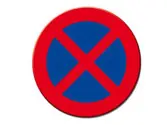
¿Podemos realizar una parada a partir de esta señal?
May we stop after this sign?
- ANo.No.
- BSí, puesto que la señal solamente prohíbe estacionar.Yes, because the sign only prohibits parking.
- CSí, siempre y cuando dure menos de 2 minutos.Yes, as long as it lasts less than 2 minutes.
ExplanationThe sign prohibits stopping and parking from the sign onwards, on the side of the carriageway where it is placed. The ban ends at the nearest junction.
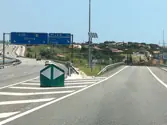
¿Podrá ser inmovilizado un vehículo en el cebreado?
May a vehicle be brought to a standstill on a hatched area?
- ANo, está prohibido.No, it is prohibited.
- BSí, si no dificulta la circulación.Yes, if it does not hinder traffic.
- CSí, siempre.Yes, always.
ExplanationNo driver may drive a vehicle into a hatched area, except those who must use the hard shoulder.
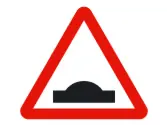
Esta señal indica advertencia de peligro debido a ...
This sign warns of danger due to...
- Aun resalto.a hump.
- Bun badén.a dip.
- Cperfil irregular.an uneven road surface.
ExplanationThe sign in the picture, showing the profile of a bump on the carriageway, warns that you are approaching a hump. A dip is indicated by a different sign, showing a hollow, and an uneven road surface by a sign showing several undulations.
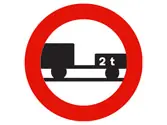
¿Podrá entrar a partir de la señal un vehículo con remolque de un solo eje?
May a vehicle with a single-axle trailer enter after this sign?
- ADependerá de su MMA.It will depend on its MAM.
- BSí.Yes.
- CNo, salvo que el remolque vaya vacío.No, unless the trailer is empty.
ExplanationThis is sign R-112 «No entry for motor vehicles with a trailer, except single-axle trailers». A single-axle trailer is exempt and may enter whatever its mass; the tonnage figure only limits trailers that are not single-axle.
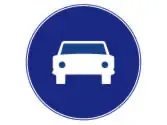
¿Una motocicleta puede circular por una calzada así señalizada?
Can a motorcycle use a carriageway marked like this?
- ANo, es una calzada exclusiva para turismos.No, this carriageway is only for cars.
- BNo, es una calzada solo para automóviles.No, this carriageway is only for motor cars.
- CSí.Yes.
ExplanationThe sign in the question requires drivers of motor cars, except motorcycles, to use the carriageway at whose entrance it is placed. So motorcycles do not have to use this carriageway, but they may.
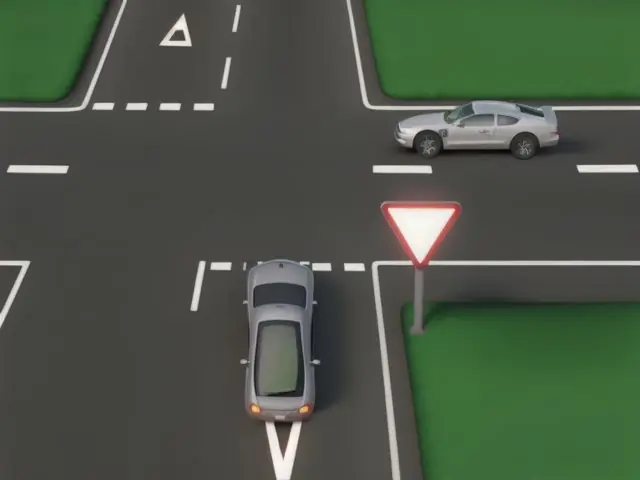
¿Qué indica la señal de la derecha?
What does the sign on the right indicate?
- AObliga a detenerse antes de la señal.It requires you to stop before the sign.
- BAvisa de un peligro.It warns of a danger.
- CObliga a ceder el paso a todos los vehículos.It requires you to give way to all vehicles.
ExplanationThe sign on the right, a white triangle with a red border pointing downwards, is the give-way sign. Under Article 56.5 of the RGC, it requires you to give way to vehicles on the priority road, whichever side they come from, stopping only if necessary.
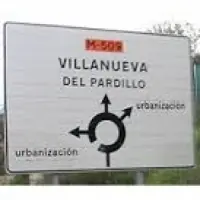
¿De qué puede advertir una señal de preseñalización?
What can an advance direction sign warn you about?
- APreseñalización de vía cerradaA closed road ahead.
- BPreseñalización de vía sinuosaA winding road ahead.
- CPreseñalización de glorietaA roundabout ahead.
ExplanationAdvance direction signs can warn, among other things, that you are approaching a roundabout, or show directions towards a conventional road or an expressway (vía rápida). So these signs can give advance warning of a roundabout, but not of a closed or winding road.
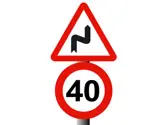
La señal prohíbe circular a más de 40 km/h. ¿Hasta dónde está prohibido?
This sign prohibits driving faster than 40 km/h. Up to what point does the prohibition apply?
- AHasta que encuentre una señal de fin de prohibido adelantar.Until you find an ‘end of no overtaking’ sign.
- BHasta que finalice el tramo de curvas.Until the stretch of bends ends.
- CHasta que finalice la línea longitudinal continua.Until the continuous longitudinal line ends.
ExplanationWhen a maximum speed sign is placed on the same post as a danger warning sign, the limit applies only while the indicated danger lasts. In this case, the ban on going faster than 40 km/h ends where the stretch of dangerous bends ends.
All topics
- Definitions
- Documents and penalty points
- The driver's condition
- Duties of drivers and pedestrians
- Vehicle safety devices
- Vehicle controls and equipment
- Vehicle lights and horn
- The road and its lanes
- Speed and distances
- Manoeuvres
- Right of way
- Carrying passengers and loads
- Driving safely in difficult conditions
- Vehicle mechanics and maintenance
- Road accidents and first aid
- Defensive and eco-driving
Independent app: not affiliated with or endorsed by the DGT (Spain's Directorate-General for Traffic) or the Ministry of the Interior. The official exam is booked with the DGT and taken at its test centres. The questions here are practice material; the DGT's official question bank is not public.
Basado en datos de la Agencia Estatal Boletín Oficial del Estado (https://www.boe.es). Textos consolidados de carácter meramente informativo. La AEBOE no patrocina ni respalda este sitio.
Parte de las preguntas procede de los tests de la revista «Tráfico y Seguridad Vial» de la DGT, reproducidos con indicación de la fuente.