
DGT test · 1,397 questions
Traffic signs, markings and signals · Page 9 of 28
Road signs, road markings, traffic lights, police signals and temporary markings: what they mean and which one wins when they disagree. The topic with the most questions in the bank.
Questions in this topic, with answers
1,397 questions, 50 per page, with the correct answer and the explanation. Page 9 of 28.
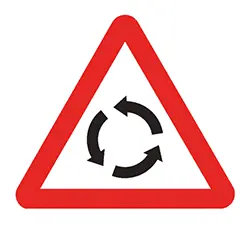
Esta señal le indica peligro por la proximidad de…
This sign warns of danger because you are approaching...
- AUn cruce con doble sentido de la circulación.a junction with two-way traffic.
- BUn cruce donde la circulación se efectúa de forma giratoria.a junction where traffic moves round in a circle.
- CUn cruce en el que tengo prioridad.a junction where I have priority.
ExplanationThe arrows in a circle inside the triangle warn of a junction where traffic moves round in a circle, such as a roundabout: as a warning sign, it warns you but does not set priority.
Cuando la luz de un semáforo presenta la silueta de un ciclo, sus indicaciones se refieren...
When a traffic light shows the silhouette of a cycle, its signals apply...
- Asolo a ciclos.only to cycles.
- Bsolo a ciclos y ciclomotores.only to cycles and mopeds.
- Csolo a ciclomotores.only to mopeds.
ExplanationAccording to Annex I of the RGC (section 4.4), when the lights of a traffic light show the illuminated silhouette of a cycle, its signals apply only to cycles. Mopeds obey the general traffic lights for vehicles.
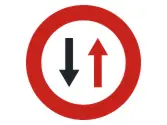
En un paso estrecho, esta señal, ¿qué indica?
At a narrow passage, what does this sign indicate?
- AQue tienen preferencia los vehículos que vienen en sentido contrario.That vehicles coming in the opposite direction have priority.
- BQue tiene preferencia el vehículo que se encuentre más próximo a la señal.That the vehicle nearest to the sign has priority.
- CQue tengo preferencia de paso.That I have right of way.
ExplanationWhen approaching a narrow passage we may find one of two signs, depending on the side from which we approach it. The first, which is the one in the question, tells us that the opposite direction has priority and prohibits us from entering the narrow passage until we can get through it without forcing vehicles travelling in the opposite direction to stop. The second, on the other hand, would tell us that we have priority over vehicles travelling in the opposite direction.
Un semáforo en verde para tu sentido de marcha en un cruce, ¿qué te permite exactamente?
What exactly does a green traffic light for your direction at a junction allow you to do?
- APasar siempre, tengas o no la vía despejadaGo through always, whether or not the road ahead is clear
- BPasar, si la vía por la que vas a entrar está despejadaGo through, if the road you are entering is clear
- CPasar solo tras detenerte primeroGo through only after stopping first
ExplanationGreen allows you to go, but only if the carriageway you are entering is clear, so that you do not get stuck in the junction.
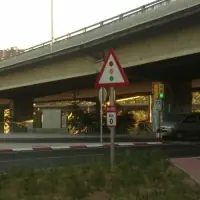
¿Cuál es la finalidad de las señales de advertencia de peligro?
What is the purpose of warning signs?
- AIndicar de una curva peligrosa únicamenteTo indicate a dangerous bend only.
- BIndicar de la proximidad de un peligro difícil de ser percibido a tiempoTo indicate that a hazard that is difficult to see in time is near.
- CIndicar que se circula por un carril reversibleTo indicate that you are in a reversible lane.
ExplanationThe main purpose of warning signs is to indicate that a hazard or obstacle is near on the road that drivers may find difficult to see in time.
¿Qué indica la señal vertical de forma triangular, borde rojo y con un ciclista dentro?
What does a triangular road sign with a red border and a cyclist inside indicate?
- AZona prohibida para la circulación de bicicletasAn area where cycling is prohibited
- BInicio de un carril solo para bicicletasThe start of a lane for bicycles only
- CPeligro por la proximidad de un paso para ciclistas o de un tramo frecuentado por ciclistasDanger because a cyclist crossing or a stretch of road often used by cyclists is near
ExplanationIt is a danger warning sign. The 2025 catalogue includes P-22a “Cyclist crossing”, warning that one or more crossings are near, and P-22b “Cyclists”, for a stretch of road with frequent cycle traffic. It does not prohibit or reserve the road: it requires you to take extreme care.
La luz amarilla fija de un semáforo, ¿le obliga siempre a detenerse?
Does a steady amber traffic light always require you to stop?
- ASí, siempre.Yes, always.
- BSí, salvo que, cuando se encienda, se encuentre el vehículo tan cerca del lugar de detención que no pueda detenerse antes del mismo en condiciones de seguridad suficiente.Yes, unless, when it comes on, the vehicle is so close to the stopping point that it cannot stop before it with sufficient safety.
- CSólo si en el mismo poste del semáforo hay una señal de STOP.Only if there is a STOP sign on the same post as the traffic light.
ExplanationThis is correct because it states that a steady amber light means that drivers must stop, unless they are so close to the traffic light that they cannot do so safely. This avoids dangerous situations, such as sudden braking that could cause accidents.
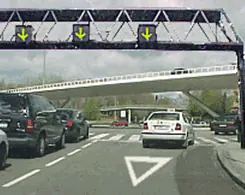
¿Cómo deberá actuar un conductor al llegar a la intersección, teniendo en cuenta el semáforo cuadrado con flecha verde existente sobre su carril, y la marca vial de ceda el paso situada en el mismo?
How should a driver act on reaching the junction, given the square traffic light with a green arrow above their lane and the give-way marking in that lane?
- ADeberá detenerse obligatoriamente antes de la marca, aunque la vía esté libre.They must stop before the marking, even if the road is clear.
- BComo el semáforo prevalece sobre las marcas viales, no debe respetar el ceda el paso.As traffic lights take priority over road markings, they need not obey the give-way marking.
- CDeberá ceder el paso a los vehículos que circulen por la vía transversal.They must give way to vehicles on the crossing road.
ExplanationSquare traffic lights with a green arrow are lane-control signals: they only show that you may drive in that lane, but they do not control the junction. So the give-way marking still applies and you must let vehicles on the crossing road pass.
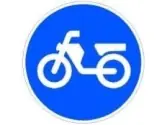
Esta señal indica vía reservada a...
This sign indicates a route reserved for...
- Aciclos y ciclomotores.cycles and mopeds.
- Bsólo a ciclomotores.mopeds only.
- Cvehículos de 2 ruedas y prohibición a los demás usuarios de la vía.two-wheeled vehicles, with other road users prohibited.
ExplanationThis sign indicates a route reserved for mopeds and prohibits all other road users from using it.
¿Qué indican los paneles direccionales?
What do directional panels indicate?
- AProhíben el paso e indican el sentido de la circulación.They prohibit passage and show the direction of traffic.
- BQue es un carril reversible.That it is a reversible lane.
- CQue la calzada está cerrada definitivamente.That the carriageway is permanently closed.
ExplanationUnder section 3.1.1 of Annex I of the RGC, the temporary directional panel is a delineating device: it prohibits passage and also shows the direction of traffic. It does not indicate a reversible lane or a permanent closure of the carriageway.
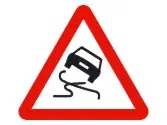
¿De qué le advierte la señal que se muestra en la imagen?
What does the sign in the picture warn you of?
- AProyección de gravilla.Loose gravel being thrown up.
- BPavimento deslizante.Slippery road surface.
- CPavimento deslizante a causa de hielo o la nieve.Road surface slippery because of ice or snow.
ExplanationSlippery road surface: danger because you are approaching a part of the carriageway where the surface may be very slippery.
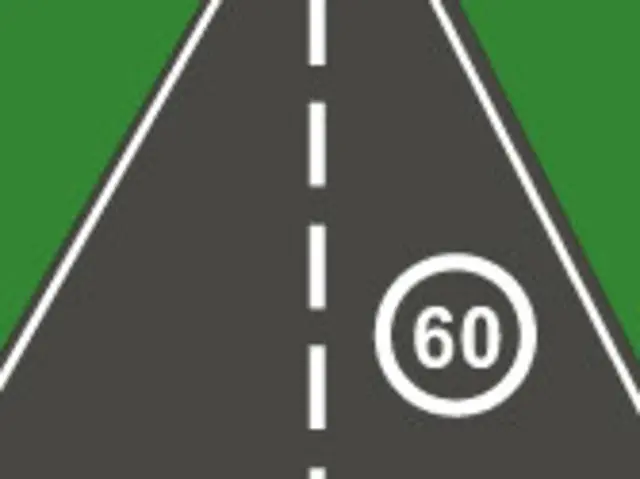
¿En cuál de las siguientes situaciones termina la limitación de velocidad indicada por esta señal?
In which of the following situations does the speed limit shown by this sign end?
- AAl pasar la línea blanca transversal que está delante de la señal.When you pass the white transverse line in front of the sign.
- BCuando se encuentre otra señal que indique un límite de velocidad distinto.When you come to another sign showing a different speed limit.
- CCuando se salga de la población y no haya viviendas cerca.When you leave the town and there are no houses nearby.
ExplanationA speed limit marking painted on the carriageway has the same meaning as the equivalent road sign. According to the catalogue of road markings in Annex I of the RGC, the limit applies until the next end-of-limit sign or until another maximum speed sign with a different value.
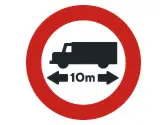
¿Esta señal afecta a los vehículos con remolque?
Does this sign apply to vehicles with a trailer?
- ANo, solo afecta a los camiones de más de 10 metros de longitud.No, it only applies to lorries more than 10 metres long.
- BSí.Yes.
- CNo, solo afecta a camiones furgones y furgonetas.No, it only applies to lorries, box lorries and vans.
ExplanationThis is sign R-203 «Length limit»: it prohibits entry to vehicles or combinations of vehicles whose maximum length, including the load, exceeds the length shown, here 10 metres. A vehicle with a trailer is a combination, so the sign applies to it if it is longer than that.
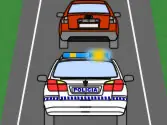
¿Qué debe hacer ante las indicaciones de los agentes?
What must you do given the police officers' signals?
- APasar por el lado izquierdo porque el agente va a parar a la derecha.Pass on the left because the officer is going to stop on the right.
- BDetenerse en el lado derecho.Stop on the right-hand side.
- CReducir la marcha.Slow down.
ExplanationIf a police vehicle positions itself behind us using its light and sound signals at the same time and also switches on a flashing red light facing forwards, it is telling us to stop the vehicle on the right-hand side of the carriageway, in a place where it does not create further risk or nuisance, and to obey the instructions the officer gives us over the loudspeaker.
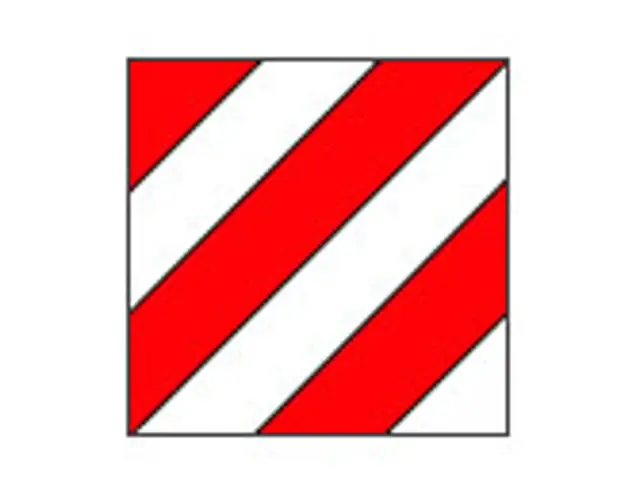
¿Las cargas que sobresalen por detrás del vehículo deben señalizarse con este panel?
Must loads sticking out at the rear of the vehicle be marked with this panel?
- ASí, y además con una luz roja tanto de día como de noche.Yes, and also with a red light both by day and at night.
- BSí, y además con un trapo de color rojo intenso.Yes, and also with a bright red cloth.
- CSí, y además, si es de noche, con una luz roja.Yes, and also, at night, with a red light.
ExplanationUnder Article 15.6 of the General Traffic Regulations, a load sticking out at the rear is marked with the V-20 panel and also, between sunset and sunrise or when visibility is considerably reduced, with a red light. During the day with good visibility, the panel is enough.
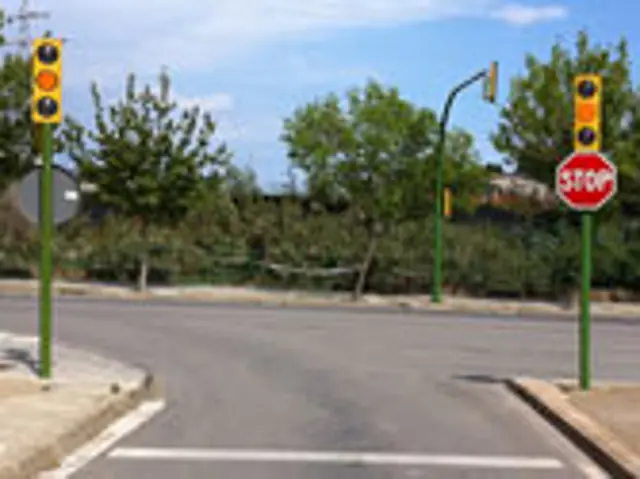
¿Qué debe hacer en esta intersección con el semáforo en amarillo intermitente?
What must you do at this junction with the traffic light flashing amber?
- AContinuar con precaución; el semáforo amarillo intermitente no le exime de respetar la señal vertical.Continue with caution; the flashing amber light does not exempt you from obeying the road sign.
- BCircular con mucha precaución y, si es necesario, ceder el paso a los vehículos que vienen de ambos lados.Drive very carefully and, if necessary, give way to vehicles coming from both sides.
- CDetener el vehículo.Stop the vehicle.
ExplanationThe picture shows a traffic light flashing amber and a STOP sign. Under section 4.2 of Annex I of the RGC, a flashing amber light requires you to take extra care, but it does not exempt you from obeying other signs that require you to stop, so you must stop at the STOP sign.
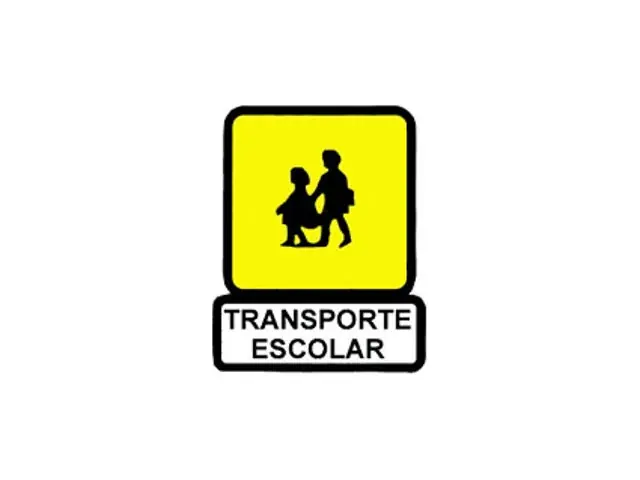
Al acercarnos a un autobús que tiene esta señal en la parte trasera y está parado recogiendo pasajeros, debemos:
When approaching a bus that has this sign on the back and is stopped picking up passengers, we must:
- AReducir la velocidad y, si es necesario, detener el vehículo.Reduce speed and, if necessary, stop the vehicle.
- BAvisar de nuestra presencia con ráfagas de luz.Warn of our presence by flashing our lights.
- CSiempre parar detrás del vehículo hasta que reanude la marcha.Always stop behind the vehicle until it moves off again.
ExplanationThe school transport sign shows that the bus is carrying children. Under Article 46.1.e of the General Traffic Regulations (RGC), when approaching a stopped bus, especially a school bus, you must drive at a moderate speed and stop if necessary.
Una línea longitudinal discontinua con los trazos más anchos, ¿qué significa?
What does a broken longitudinal line with wider dashes mean?
- AQue es un carril reversible.That it is a reversible lane.
- BQue es un carril especial.That it is a special lane.
- CQue es un carril de autobús.That it is a bus lane.
ExplanationWhen the dashes of a broken line are wider, it means that it is a special lane, for example a bus lane.
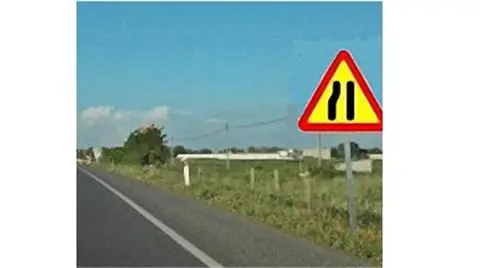
La señal de la foto indica...
The sign in the photo indicates...
- Aestrechamiento por la derecha.road narrows on the right.
- Bestrechamiento por la izquierda.road narrows on the left.
- Cestrechamiento por la derecha y por la izquierda.road narrows on both sides.
ExplanationThe warning sign shows the left-hand line bending inwards: it warns that the carriageway narrows on the left. The yellow background shows that it is a roadworks sign.
¿Qué tendremos que hacer ante un semáforo con luz amarilla fija?
What must we do at a traffic light showing a steady amber light?
- APasar con precaución.Go through carefully.
- BDetenernos.Stop.
- CCeder el paso a derecha e izquierda.Give way to the right and left.
ExplanationAt a traffic light showing a steady amber light we must stop as if it were red. If it were flashing amber, we would go through taking extreme care and giving way.
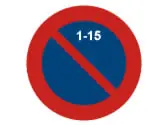
Si hoy es día 10, ¿podremos efectuar una parada a partir de la señal?
If today is the 10th, may you stop after the sign?
- ASí.Yes.
- BNo.No.
- CNo, porque estamos en la primera quincena del mes.No, because it is the first half of the month.
ExplanationThe sign prohibits parking but allows stopping, so you may always stop after the sign.
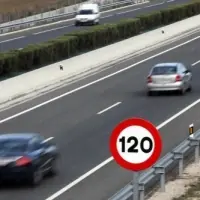
¿Qué significado tienen las señales de tráfico de forma circular y de color rojo?
What do circular red road signs mean?
- APeligroDanger
- BProhibición o restricciónProhibition or restriction
- CObligaciónObligation
ExplanationCircular red road signs tell you that you will find some kind of restriction or prohibition on the road you are using. One example of this type of sign is the sign prohibiting entry to a road (no entry).
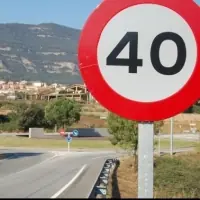
¿Qué significa una señal pintada en la calzada con un 40 dentro de un círculo?
What does a sign painted on the carriageway with 40 inside a circle mean?
- AQue la velocidad mínima en esa vía es de 40 km/h.That the minimum speed on that road is 40 km/h.
- BQue por ese carril no pueden pasar vehículos de más de 4 toneladas.That vehicles over 4 tonnes may not use that lane.
- CQue no se puede circular a más de 40 km/h.That you may not drive faster than 40 km/h.
ExplanationSigns painted on the carriageway have the same meaning as road signs: a 40 in a circle sets the maximum speed at 40 km/h. It applies until an end-of-limit sign or another maximum speed sign and, if it is in a marked lane, only to that lane.
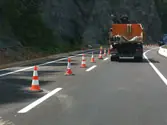
¿Se puede atravesar la línea de conos para cambiar de carril?
May you cross the line of cones to change lanes?
- ASí, para realizar una parada.Yes, to stop.
- BSí, para adelantar.Yes, to overtake.
- CNo, porque está prohibido.No, because it is prohibited.
ExplanationSmall flags, cones or similar devices prohibit passing through the real or imaginary line that joins them. They are temporary signs and take precedence over all other signs, except orders from traffic officers.
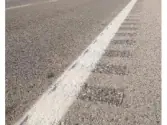
¿Qué función tienen las guías sonoras situadas en el borde derecho de la calzada, ubicadas normalmente en el arcén coincidiendo con la marca vial que delimita el carril derecho?
What is the purpose of the rumble strips on the right-hand edge of the carriageway, usually placed on the hard shoulder along the road marking that edges the right-hand lane?
- AAlertar al conductor en caso de que se desvíe de la trayectoria de su carril.To alert the driver if they drift out of their lane.
- BBalizar el borde de la calzada, especialmente en condiciones de baja visibilidad.To mark the edge of the carriageway, especially in poor visibility.
- CIndicar la existencia de un carril especial o reservado a determinados vehículos.To show that there is a special lane or a lane reserved for certain vehicles.
ExplanationRumble strips on the right-hand edge of the carriageway, usually placed on the hard shoulder along the road marking that edges the right-hand lane, are there to alert the driver if they drift out of their lane. These strips, also known as «sound strips», cause vibration and noise when the vehicle's tyres run over them, warning the driver that they are leaving their lane. This helps to prevent accidents, especially in situations of tiredness, distraction or drowsiness at the wheel.
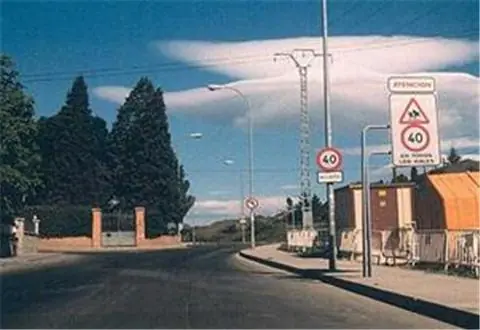
Las señales del panel, ¿qué indican?
What do the signs on the panel indicate?
- AEl límite de velocidad en un tramo frecuentado por niños.The speed limit on a stretch frequented by children.
- BEl límite de velocidad a 40 kilómetros por hora en esta travesía.A speed limit of 40 kilometres per hour on this travesía (stretch of road through a town).
- CEl límite de velocidad a 40 kilómetros por hora para los vehículos que giren a la derecha.A speed limit of 40 kilometres per hour for vehicles turning right.
ExplanationWhen a speed limit appears on the same panel as a warning sign, in this case for children, the limit applies for as long as that hazard lasts, that is, on the stretch frequented by children. It does not refer to vehicles turning or to the whole travesía.
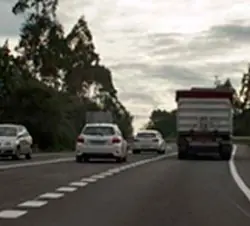
La línea discontinua, ¿qué indica?
What does the broken line indicate?
- AUn carril especial.A special lane.
- BLa cercanía a una línea longitudinal continua.That a solid longitudinal line is coming up.
- CUn carril reversible.A reversible lane.
ExplanationA broken line that is wider than normal marks out a special lane, such as a deceleration, acceleration or reserved lane; its greater width distinguishes it from the line separating ordinary lanes.
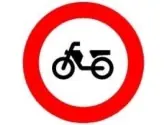
Esta señal prohíbe el acceso a los ciclomotores y a...
This sign prohibits access to mopeds and to...
- Alas motocicletas.motorcycles.
- Blas bicicletas.bicycles.
- Clos vehículos para personas de movilidad reducida.vehicles for people with reduced mobility.
ExplanationIt prohibits access to two- and three-wheeled mopeds, light quadricycles and vehicles for people with reduced mobility.
Ante un semáforo en amarillo no intermitente, ¿qué haremos?
What will we do at a non-flashing amber traffic light?
- ADetenernos.Stop.
- BPasar con precaución.Go through with caution.
- CCeder el paso a derecha e izquierda.Give way to the right and left.
ExplanationAt a non-flashing amber traffic light we must stop as if it were a steady red one. If the light is flashing amber, we may go through taking extra care.
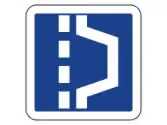
Esta señal nos indica...
This sign tells us...
- AQue existe una zona de descanso en la autopista.That there is a rest area on the motorway.
- BQue existe un apartadero donde apartar el vehículo en caso de emergencia.That there is a lay-by where you can pull the vehicle over in an emergency.
- CQue existe una zona de parada de autobuses.That there is a bus stop area.
ExplanationThis is sign S-34 'Lay-by': it indicates a place where you can pull the vehicle over in an emergency to keep the road clear. A lay-by in a tunnel with an emergency telephone has its own sign, S-34a.
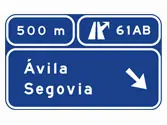
Viendo esta señal sabremos que estamos circulando por...
Seeing this sign, you will know that you are driving on...
- AUna autopista.A motorway (autopista).
- BUna autovía.A dual carriageway (autovía).
- CUna autopista o una autovía.A motorway (autopista) or a dual carriageway (autovía).
ExplanationThis is an advance direction sign with a side panel on a motorway or dual carriageway (S-225): it shows the destinations of the exit at the next interchange, the distance to it, its number and, where applicable, its letter. It is used in the same way on motorways and dual carriageways, so it does not let you tell them apart.
Si, circulando por una carretera convencional, se encuentra un semáforo que con luz amarilla intermitente, y poco después hay otro semáforo con luz roja intermitente, ¿cómo se debe actuar?
If, driving on a conventional road, you come to a traffic light with a flashing amber light and shortly afterwards another traffic light with a flashing red light, how should you act?
- AExtremando las precauciones, tanto en uno como en el otro semáforo, cediendo el paso a los vehículos si se acercasen por la derecha.Taking extra care at both traffic lights, giving way to vehicles if they approach from the right.
- BPasando el primer semáforo extremando la precaución, y deteniéndose en el segundo semáforo hasta que cambie de color o se apague.Passing the first traffic light with extra care, and stopping at the second one until it changes colour or goes out.
- CExtremando la precaución al pasar por el primer semáforo y deteniéndose en el segundo semáforo hasta que esté seguro de que puedo continuar la marcha sin peligro, cediendo el paso a cualquier vehículo que se aproximase por la vía transversal.Taking extra care when passing the first traffic light and stopping at the second one until I am sure I can continue without danger, giving way to any vehicle approaching on the crossing road.
ExplanationA flashing amber light requires you to take extra care and, where appropriate, to give way. A flashing red light prohibits passing, like a steady red light, so you must stop at the second traffic light until it goes out or changes. It is often used at level crossings or lifting bridges.
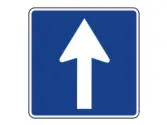
Esta señal, ¿nos impide cambiar de dirección a la izquierda?
Does this sign prevent us from turning left?
- ASí.Yes.
- BSí, solo permite seguir de frente.Yes, it only allows you to go straight on.
- CNo.No.
ExplanationThis sign tells us that the carriageway is one-way; it does not prohibit turning, but it does prohibit U-turns.
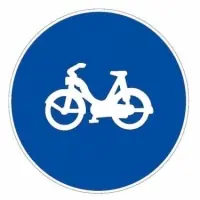
¿Puede una motocicleta conducir por una carretera señalizada con esta señal de tráfico?
May a motorcycle be ridden on a road marked with this traffic sign?
- ASí, si se trata de una motocicleta con sidecar.Yes, if it is a motorcycle with a sidecar.
- BNo, porque se trata de una vía que está destinada exclusivamente a la circulación de ciclomotores.No, because it is a road reserved exclusively for mopeds.
- CSí, porque se trata de una vía destinada a la circulación de vehículos de dos ruedas.Yes, because it is a road for two-wheeled vehicles.
ExplanationThis sign indicates a road reserved exclusively for mopeds, so other vehicles may not use it, including motorcycles, with or without a sidecar. Having two wheels does not make a motorcycle a moped.
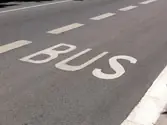
¿Qué vehículos podrán circular por un carril reservado para la circulación con la inscripción BUS?
Which vehicles may use a reserved lane marked BUS?
- ATodos los vehículos de transporte público de pasajeros.All public passenger transport vehicles.
- BLos autobuses.Buses.
- CLos autocares, taxis y ciclos.Coaches, taxis and cycles.
ExplanationA lane marked BUS is reserved for buses. If the line marking it is broken, other vehicles may use it only for a manoeuvre other than stopping, parking, making a U-turn or overtaking, and always giving priority to buses.
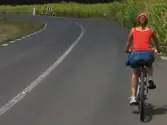
Si tenemos que adelantar a un ciclista, ¿en algún momento podemos traspasar la línea continua?
If you have to overtake a cyclist, may you ever cross the continuous line?
- ASí, pero solo en poblado.Yes, but only in built-up areas.
- BSí.Yes.
- CNo.No.
ExplanationUnder Article 88.2 of the General Traffic Regulations (RGC) (as worded by RD 518/2026), where overtaking is prohibited you may overtake cyclists by using the part of the carriageway for the opposite direction, even crossing the continuous line, if their speed allows it to be done without risk. You must leave at least 1.5 metres (Article 85.4).
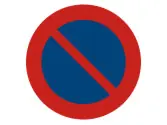
¿Podrá parar a partir de esta señal?
May you stop after this sign?
- ASí.Yes.
- BNo, salvo para cargar y descargar mercancías.No, except to load and unload goods.
- CNo.No.
ExplanationThe sign in the question prohibits parking but allows stopping. Unless shown otherwise, the ban starts level with the sign and ends at the nearest junction.
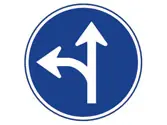
A la vista de la señal, ¿podremos realizar un cambio de sentido de la marcha?
Given the sign, may we make a U-turn?
- ASí.Yes.
- BNo.No.
- CSí, si no circulan vehículos en sentido contrario.Yes, if no vehicles are coming the other way.
ExplanationThe arrows show the only directions vehicles may take. In this case, you may only go straight on or turn left; making a U-turn is not allowed.
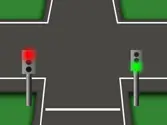
En el lado izquierdo y derecho de esta intersección existen semáforos con indicaciones distintas, ¿a qué semáforo obedeceremos si queremos continuar de frente?
On the left and right sides of this junction there are traffic lights showing different signals. Which traffic light will we obey if we want to go straight on?
- AAl más restrictivo.The most restrictive one.
- BAl situado a la derecha.The one on the right.
- CAl situado a la izquierda.The one on the left.
ExplanationTo go straight on or turn left, we obey the traffic light on the left, while to turn right we obey the traffic light on the right-hand side.
¿Qué debe hacer si se acerca de frente a un agente que mueve el brazo alternativamente de arriba abajo?
What should you do if you are approaching, from the front, an officer who is moving their arm alternately up and down?
- AGirar hacia el lado que indica el brazo.Turn towards the side the arm indicates.
- BDisminuir la velocidad.Slow down.
- CDetenerme inmediatamente en el lado que indique el brazo.Stop immediately on the side the arm indicates.
ExplanationThe correct answer is to slow down, because when an officer moves their arm alternately up and down, they are telling vehicles approaching on the side of the arm making the movement to reduce speed.
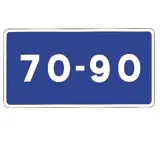
Esta señal recomienda mantener la velocidad entre los valores indicados...
This sign recommends keeping your speed between the values shown...
- ASiempre que las condiciones meteorológicas o ambientales sean favorables.provided the weather or environmental conditions are favourable.
- BCuando las condiciones meteorológicas o ambientales sean desfavorables.when the weather or environmental conditions are unfavourable.
- CEn cualquier caso.in all cases.
ExplanationThis is the recommended speed range sign: it recommends driving between the two figures shown when the weather, environmental, road and traffic conditions are favourable. If they are unfavourable, you will have to go more slowly. It is not an obligation.
Un toque largo de silbato emitido por un agente de la circulación, ¿qué indica?
What does one long whistle blast from a traffic officer indicate?
- AReanudación de la marcha.Move off again.
- BDetención obligatoria.Stop.
- CDisminución de la velocidad.Slow down.
ExplanationOne long whistle blast from a traffic officer indicates that vehicles may move off again. This usually happens after they have been stopped, whether at a red light or for other reasons that required vehicles to stop. The whistle is a clear signal that it is safe to continue.
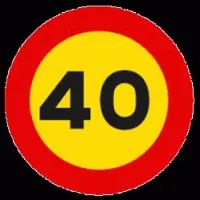
¿Cuál es la principal finalidad de las señales de reglamentación?
What is the main purpose of regulatory signs?
- AIndicar a los conductores que aumenten la observanciaTo tell drivers to be more observant.
- BIndicar a los conductores sus obligacionesTo tell drivers their obligations.
- CIndicar a los conductores que deben conducir por la izquierdaTo tell drivers that they must drive on the left.
ExplanationUnder Article 145.1 of the General Traffic Regulations (RGC), regulatory signs are meant to tell road users the special obligations, limits or prohibitions they must observe, such as a maximum speed or a ban on overtaking.
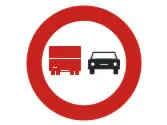
Esta señal prohíbe adelantar a...
This sign prohibits overtaking by...
- Aa todos los camiones.all lorries.
- Ba los camiones de más de 3.500 kg.lorries over 3,500 kg.
- Ca los camiones y a los autobuses.lorries and buses.
ExplanationThis sign prohibits lorries whose maximum authorised mass (MAM) exceeds 3,500 kg from overtaking; lorries of up to 3,500 kg may overtake.
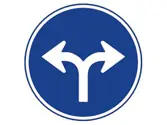
¿Esta señal permite efectuar un cambio de sentido?
Does this sign allow a U-turn?
- ASí.Yes.
- BNo.No.
- CSí, si no circulan vehículos en sentido contrario.Yes, if there are no vehicles coming the other way.
ExplanationThe arrows on the sign show the only directions that vehicles may take, so making a U-turn is not allowed.
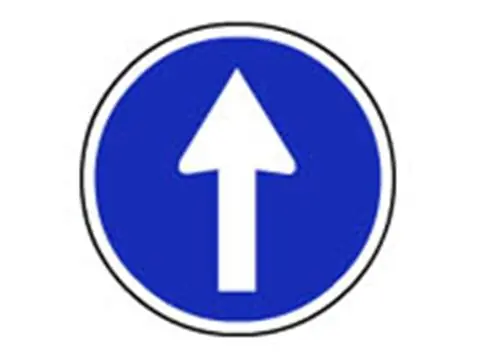
Esta señal indica dirección y sentido...
This sign indicates a direction that is...
- Aaconsejados.recommended.
- Bobligatorios.compulsory.
- Cprohibidos.prohibited.
ExplanationRound blue signs are mandatory signs. This one, with an arrow pointing up, indicates a compulsory direction: you must go straight on in the direction shown by the arrow. It is neither a recommendation nor a prohibition.
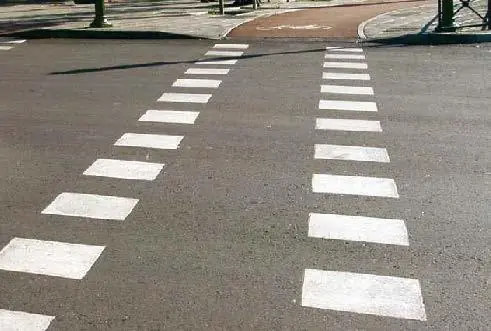
Fuera de los pasos regulados por semáforo, ¿qué indican dos líneas transversales, discontinuas y paralelas?
Away from crossings controlled by traffic lights, what do two parallel, broken transverse lines indicate?
- APaso para peatones.A pedestrian crossing.
- BCarril adicional.An additional lane.
- CPaso para ciclistas.A cycle crossing.
ExplanationTwo parallel, broken transverse lines form marking M-4.4, cycle crossing: vehicles on the carriageway must let cyclists cross. Only at pedestrian crossings controlled by traffic lights may this marking also be used.
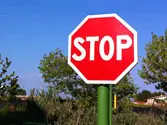
La señal de STOP, ¿obliga a detenerse?
Does the STOP sign require you to stop?
- ASolo si se acerca algún vehículo.Only if a vehicle is approaching.
- BSiempre.Always.
- CSolo si tenemos que ceder el paso.Only if we have to give way.
ExplanationA STOP sign requires you, in all cases, to stop in order to give way, at the next stop line or, if there is none, immediately before the junction.
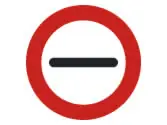
¿Qué hará usted a la vista de esta señal?
What will you do when you see this sign?
- ADetenerme.Stop.
- BPasar con precaución.Go through carefully.
- CCeder el paso a todos los vehículos.Give way to all vehicles.
ExplanationThis sign shows the place where you must stop because you are approaching a customs post, a police checkpoint, a toll booth or for another reason.
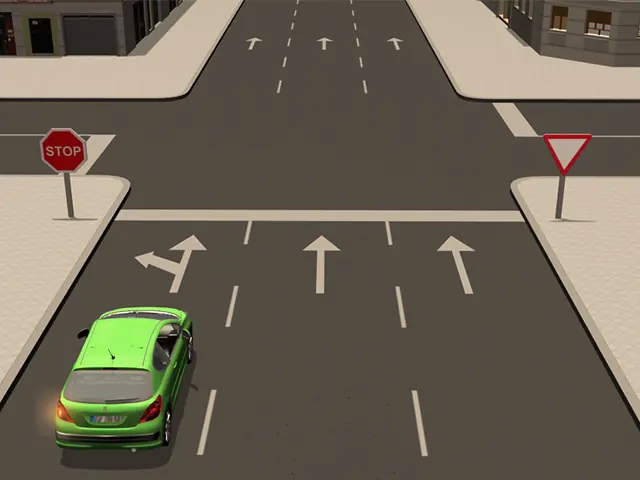
En este cruce, ¿qué indican las flechas del carril izquierdo?
At this junction, what do the arrows in the left lane indicate?
- AMe informan, no me obligan.They inform me; they do not oblige me.
- BMe obligan a girar a la izquierda.They oblige me to turn left.
- CMe obligan a girar a la izquierda o continuar recto.They oblige me to turn left or go straight on.
ExplanationIn lanes with arrows painted on the road surface, the arrows show the directions a vehicle in that lane may follow. When there are several arrows in the same lane, they show the manoeuvres allowed from it, such as going straight on or turning. These markings are mandatory, so the driver must follow the directions shown. Their purpose is to organise traffic and avoid conflicts at the junction. So they are not just for information.
All topics
- Definitions
- Documents and penalty points
- The driver's condition
- Duties of drivers and pedestrians
- Vehicle safety devices
- Vehicle controls and equipment
- Vehicle lights and horn
- The road and its lanes
- Speed and distances
- Manoeuvres
- Right of way
- Carrying passengers and loads
- Driving safely in difficult conditions
- Vehicle mechanics and maintenance
- Road accidents and first aid
- Defensive and eco-driving
Independent app: not affiliated with or endorsed by the DGT (Spain's Directorate-General for Traffic) or the Ministry of the Interior. The official exam is booked with the DGT and taken at its test centres. The questions here are practice material; the DGT's official question bank is not public.
Basado en datos de la Agencia Estatal Boletín Oficial del Estado (https://www.boe.es). Textos consolidados de carácter meramente informativo. La AEBOE no patrocina ni respalda este sitio.
Parte de las preguntas procede de los tests de la revista «Tráfico y Seguridad Vial» de la DGT, reproducidos con indicación de la fuente.