
DGT test · 1,397 questions
Traffic signs, markings and signals · Page 28 of 28
Road signs, road markings, traffic lights, police signals and temporary markings: what they mean and which one wins when they disagree. The topic with the most questions in the bank.
Questions in this topic, with answers
1,397 questions, 50 per page, with the correct answer and the explanation. Page 28 of 28.
¿Qué indica una luz verde fija en un semáforo?
What does a steady green light on a traffic light indicate?
- APrecauciónCaution
- BPaso permitidoYou may go
- CPeligroDanger
ExplanationUnder Annex I of the General Traffic Regulations (RGC), a non-flashing green light allows you to go with priority, unless the traffic situation suggests that the vehicle will end up stopped inside the junction or on a pedestrian or cyclist crossing.
¿Qué indica una luz amarilla no intermitente en un semáforo circular?
What does a non-flashing amber light on a circular traffic light indicate?
- ADetención como si se tratara de una luz rojaStop, as if it were a red light
- BPermitido el paso con prioridadYou may go, with priority
- CObligación de ceder el paso a los vehículos que circulen por la vía transversalYou must give way to vehicles on the crossing road
ExplanationA non-flashing amber light on a traffic light for vehicles tells road users that they must stop at it under the same conditions as for a steady red light.
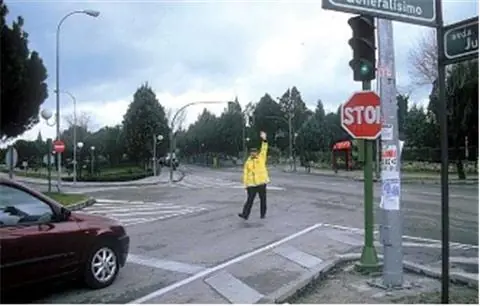
Un conductor, ¿puede atravesar una intersección regulada por un agente de tráfico que tiene el brazo levantado verticalmente?
Can a driver cross a junction controlled by a traffic officer who has one arm raised vertically?
- ASí, se detendrá justo delante del agente.Yes, and will stop right in front of the officer.
- BNo, debe detenerse antes de entrar en la intersección.No, the driver must stop before entering the junction.
- CSi, cediendo el paso a los vehículos que se aproximen por la derecha.Yes, giving way to vehicles approaching from the right.
ExplanationAn arm raised vertically requires everyone approaching the officer to stop. At a junction, you must stop before entering it; only those who are already inside it or cannot stop safely may continue. The officer's signal takes precedence over priority rules.
Modificar la señalización en la vía está:
Altering the signs on the road is:
- AProhibido, salvo causa justificada.Prohibited, except for a justified reason.
- BNo está prohibido, pero no es recomendable.Not prohibited, but not advisable.
- CPermitido siempre que la modificación aclare el sentido de la señalización.Permitted, provided the change makes the meaning of the signs clearer.
ExplanationUnder Article 140.2 of the RGC, except for a justified reason, nobody may install, remove, move, hide or alter the signs on a road without permission from the road owner or the authority responsible for traffic.
¿Qué deben hacer los conductores si un carril está delimitado a ambos lados por una línea doble discontinua?
What must drivers do if a lane is marked out on both sides by a double broken line?
- ASeguir las indicaciones marcadas por los semáforos, porque la circulación puede estar regulada en uno o en otro sentido.Follow the traffic lights, because traffic may be allowed in one direction or the other.
- BUtilizarlo solamente para adelantar.Use it only to overtake.
- CNo circular por él, porque la circulación está prohibida.Not drive in it, because traffic is prohibited.
ExplanationA lane marked out on both sides by double broken lines is a reversible lane: its direction of traffic changes and is controlled by lane-control signals or other means, which you must follow. By day you must have at least dipped headlights on in it.
¿Se podrá utilizar la señal acústica para adelantar dentro de poblado?
May the horn be used to overtake in a built-up area?
- ASí.Yes.
- BNo.No.
- CSí, si el vehículo que nos precede circula muy despacio.Yes, if the vehicle in front is going very slowly.
ExplanationThe horn may be used to warn that you are overtaking only outside built-up areas.
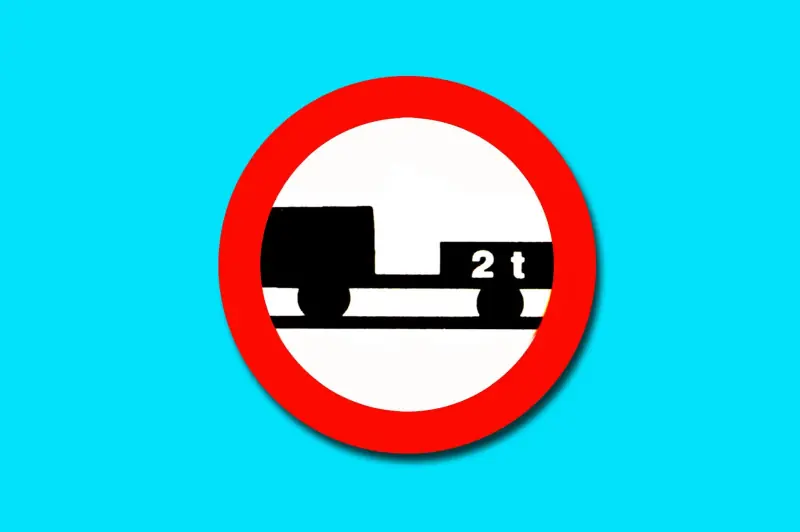
Esta señal, ¿prohíbe la entrada a remolques de un solo eje?
Does this sign prohibit entry to single-axle trailers?
- ASí, porque es un remolque.Yes, because it is a trailer.
- BNo, salvo que supere la MMA indicada en la señal.No, unless it exceeds the maximum authorised mass (MAM) shown on the sign.
- CNo.No.
ExplanationSign R-112, no entry for motor vehicles towing a trailer except single-axle trailers, does not apply to single-axle trailers. The figure of 2 t only limits the prohibition to trailers whose maximum authorised mass exceeds that value.
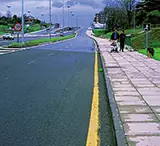
La marca vial amarilla continua, ¿qué indica?
What does the solid yellow road marking indicate?
- AProhíbe estacionar solamente.It prohibits parking only.
- BProhíbe hacer parada y estacionar.It prohibits stopping and parking.
- CProhíbe hacer parada solamente.It prohibits stopping only.
ExplanationA solid longitudinal yellow road marking on the kerb or next to the edge of the carriageway prohibits both stopping and parking along its whole length and on the side where it is placed.
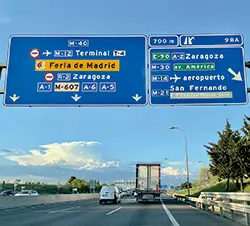
Las señales azules, ¿qué indican?
What do the blue signs indicate?
- AQue la autopista se termina.That the motorway ends.
- BQue la autopista es de peaje.That it is a toll motorway.
- CLos carriles para ir a otras carreteras o poblaciones.The lanes to take to reach other roads or towns.
ExplanationOn a motorway (autopista), the blue direction panels show the directions and the lanes to take to exit towards other roads or towns.
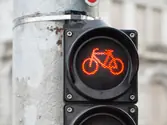
Este semáforo afecta...
This traffic light applies...
- Asolo a los ciclos.only to cycles.
- Ba los ciclos y ciclomotores.to cycles and mopeds.
- Ca los vehículos de dos ruedas.to two-wheeled vehicles.
ExplanationAccording to Annex I of the RGC (section 4.4), when the lights of a traffic light show the illuminated silhouette of a cycle, its signals apply only to cycles. Mopeds must obey the general traffic lights for vehicles.
Una cuadrícula de marcas amarillas pintada en la calzada indica...
A grid of yellow markings painted on the carriageway indicates...
- Aque está prohibido estacionar.that parking is prohibited.
- Bque no se debe franquear la intersección.that you must not cross the junction.
- Cque no se debe entrar en la intersección si se puede quedar detenido en ella y así obstaculizar la circulación.that you must not enter the junction if you may end up stopped in it and so obstruct traffic.
ExplanationThe grid of yellow markings (M-7.10) reminds you that you must not enter a junction, even if the traffic light allows it or you have right of way, if you are likely to end up stopped in it, blocking or obstructing crossing traffic.
Si en una intersección existen semáforos con indicaciones distintas a derecha e izquierda y pretendemos seguir circulando de frente, ¿a qué semáforo obedeceremos?
If, at a junction, there are traffic lights with different instructions on the right and on the left and you intend to go straight on, which traffic light do you obey?
- AAl semáforo situado a la derecha.The traffic light on the right.
- BAl semáforo situado a la izquierda.The traffic light on the left.
- CAl que tenga la indicación más restrictiva.The one with the most restrictive instruction.
ExplanationIn this case, when you intend to go straight on or turn left, you obey the traffic light on the left, and when you intend to turn right, you obey the traffic light on the right.
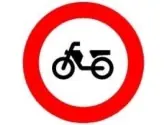
Si circula con un cuatriciclo ligero, ¿le afectará esta señal?
If you are driving a light quadricycle, does this sign apply to you?
- ANo, solo afecta a los ciclomotores.No, it only applies to mopeds.
- BSí.Yes.
- CNo, solo afecta a los ciclomotores de dos o tres ruedas.No, it only applies to two- or three-wheeled mopeds.
ExplanationSign R-105 “No entry for mopeds” prohibits access to mopeds and also to vehicles for people with reduced mobility. Under Annex II of the General Vehicle Regulations (RGV), a light quadricycle counts as a moped, so the sign also applies to it.
¿Para qué sirven las guías sonoras colocadas en el borde derecho de la calzada, normalmente en el arcén junto a la línea que delimita el carril derecho?
What are rumble strips on the right-hand edge of the carriageway for, usually on the hard shoulder next to the line marking the right-hand lane?
- AAvisar al conductor si se sale de su carril.To warn the driver if they leave their lane.
- BSeñalar el borde de la calzada, sobre todo con poca visibilidad.To mark the edge of the carriageway, especially in poor visibility.
- CIndicar la existencia de un carril especial o reservado para determinados vehículos.To show that there is a special lane or a lane reserved for certain vehicles.
ExplanationAccording to Annex I of the General Traffic Regulations (RGC), rumble strips are small grooves in the road surface or raised ridges on the road marking that produce vibration or noise when driven over, to warn the driver that they are unintentionally drifting off course.
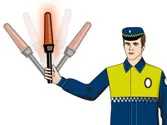
¿Qué indica un agente que balancea una luz amarilla?
What does a traffic officer swinging a yellow light indicate?
- AObliga a detenerse a los usuarios de la vía a los que el agente dirija la luz.Road users towards whom the officer points the light must stop.
- BObliga a disminuir la velocidad a los conductores que se acerquen al agente.Drivers approaching the officer must slow down.
- CObliga a pasar por el lado que indica la luz.You must pass on the side shown by the light.
ExplanationA traffic officer swinging a red or yellow light requires road users towards whom the officer points the light to stop. If the officer wanted us to slow down, they would move their arm up and down.
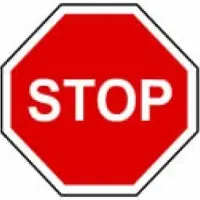
¿Qué significado tienen las señales circulares de color rojo?
What do round red signs mean?
- AProhibiciónProhibition.
- BPaso permitidoEntry allowed.
- CPrecauciónCaution.
ExplanationRound red signs prohibit certain types of vehicle, such as lorries or motorcycles, from entering the road. They also prohibit actions such as stopping, parking or turning.
La luz amarilla intermitente de un semáforo...
A flashing amber traffic light...
- ALe obliga a detenerse como si se trata de una luz roja fija.Requires you to stop as if it were a steady red light.
- BLe indica solamente precaución.Only tells you to be careful.
- CObliga a los conductores a extremar la precaución y, cuando sea necesario, a ceder el paso. Además, no exime del cumplimiento de otras señales que obliguen a detenerse.Requires drivers to take extreme care and, when necessary, to give way. It also does not exempt them from obeying other signs that require them to stop.
ExplanationThis is correct because a flashing amber light does require drivers to take extreme care and to give way when necessary. It also does not exempt them from obeying other signs that may require them to stop, such as a STOP sign.
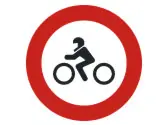
Esta señal prohíbe el acceso...
This sign prohibits access...
- Asolo a ciclos.to cycles only.
- Ba todos los vehículos de 2 ruedas.to all two-wheeled vehicles.
- Ca las motocicletas y a los vehículos de tres ruedas asimilados a ellas.to motorcycles and to three-wheeled vehicles treated as motorcycles.
ExplanationThis is sign R-104, no entry for motorcycles: it prohibits access to motorcycles and to three-wheeled vehicles treated as motorcycles. It does not apply to cycles or mopeds, even though they also have two wheels.
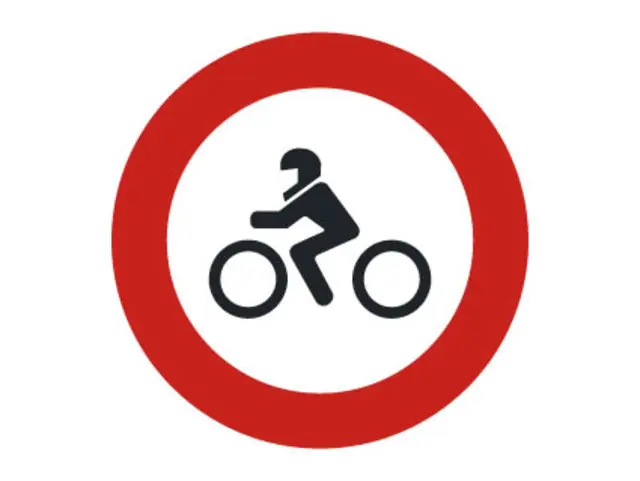
¿Se permite circular en ciclomotor por una vía que tiene esta señal en la entrada?
May you ride a moped on a road with this sign at its entrance?
- ANo, prohíbe el paso de todos los vehículos motorizados de dos ruedas.No, it prohibits all motorised two-wheelers.
- BSí.Yes.
- CNo, las bicicletas y los ciclomotores están prohibidos.No, bicycles and mopeds are prohibited.
ExplanationThe sign in the picture, with a motorcycle inside a circle with a red border, prohibits entry to motorcycles. It does not apply to mopeds, which have their own no-entry sign, so you may ride a moped on that road.
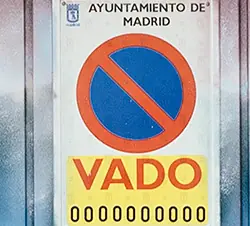
Delante de un vado, esta señal prohíbe…
In front of a driveway entrance (vado), this sign prohibits...
- Ala parada y el estacionamiento.stopping and parking.
- Búnicamente la parada.only stopping.
- Csolamente el estacionamiento.only parking.
ExplanationThe no-parking sign in front of the driveway entrance only prevents parking; stopping (a brief halt without leaving the vehicle) is still allowed.
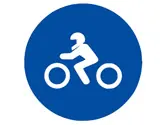
¿Un turismo podrá circular por la calzada así señalizada?
Can a car use a carriageway marked like this?
- ASí.Yes.
- BNo.No.
- CSolo para acceder a un garaje o inmueble de la vía.Only to reach a garage or a building on that road.
ExplanationSign R-405 “Compulsory carriageway for two-wheeled motorcycles” requires two-wheeled motorcycles and three-wheeled vehicles treated as motorcycles to use that carriageway, but it does not stop other vehicles from using it, so a car may use it.
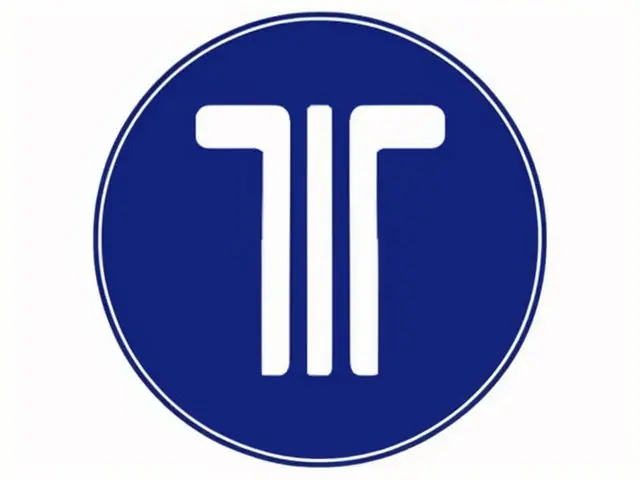
Esta señal, en un carril de acceso a un peaje, obliga a quienes circulan por él a...
This sign, in a lane leading to a toll, requires those using the lane to...
- Apagar mediante telepeaje o por otros medios.pay by electronic toll or by other means.
- Butilizarlo aunque el vehículo no disponga de un sistema de telepeaje operativo.use it even if the vehicle does not have a working electronic toll system.
- Cpagar únicamente mediante el sistema de peaje dinámico o telepeaje.pay only by the dynamic toll or electronic toll system.
ExplanationThe sign in the picture reserves the lane for vehicles that pay by dynamic toll or electronic toll, with no other means of payment. Under Article 132.1 of the RGC, vehicles using these tolls must carry the technical device that allows them to be used, in working order.
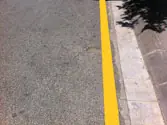
Una línea amarilla longitudinal continua indica qué...
A continuous yellow longitudinal line indicates that...
- AEl estacionamiento y la parada están prohibidos .Parking and stopping are prohibited.
- BEl estacionamiento está prohibido .Parking is prohibited.
- CSe están efectuando obras en la calzada.Roadworks are being carried out on the carriageway.
ExplanationA continuous yellow line on the kerb, or next to the edge of the carriageway, means that stopping and parking are prohibited, or subject to a temporary restriction shown by signs, along the whole length of the line and on the side where it is painted.
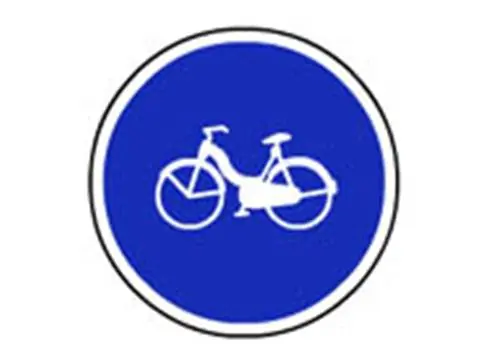
¿Qué vehículos están obligados a circular por una vía con esta señal?
Which vehicles must use a road with this sign?
- ALos ciclos y las bicicletas.Cycles and bicycles.
- BLos ciclomotores, únicamente.Only mopeds.
- CLos ciclos y los ciclomotores.Cycles and mopeds.
ExplanationThis sign indicates a road reserved for mopeds: moped riders must use it, and other road users, including bicycles, may not use it.
Con su turismo se aproxima a una intersección regulada por un agente de circulación. ¿Qué debe hacer si el agente le hace señales con el brazo izquierdo extendido moviéndolo alternativamente de arriba abajo?
You are driving your car towards a junction controlled by a traffic officer. What must you do if the officer signals to you with the left arm held out, moving it alternately up and down?
- ADetenerme.Stop.
- BDisminuir la velocidad.Slow down.
- CCambiar de dirección a la izquierda.Turn left.
ExplanationSlowing down is correct because the officer's signal means that drivers must reduce speed as they approach the junction. This makes traffic flow more safely and in a more orderly way, and the driver is prepared for any change in the traffic situation.
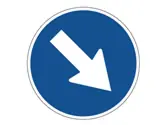
La señal obliga...
This sign requires you...
- Aa circular por el lado del refugio que indica.to pass the traffic island on the side it shows.
- Ba girar a la derecha en la próxima intersección.to turn right at the next junction.
- Ca seguir el movimiento giratorio que indica.to follow the circular movement it shows.
ExplanationThe sign in the photo requires you to pass the traffic island on the side shown by the arrow. In this case you must drive past on the right-hand side of the island.
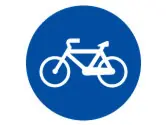
¿Un ciclomotor podrá circular por una vía así señalizada?
Can a moped use a road marked like this?
- ASí, por permitirlo la señal.Yes, because the sign allows it.
- BNo, por prohibirlo la señal .No, because the sign prohibits it.
- CSí, tendrá que circular por la vía así señalizada obligatoriamente.Yes, it must use the road marked like this.
ExplanationThe sign in the question requires cyclists to use the road marked like this and prohibits all other road users from using it. Therefore mopeds may not use this road.
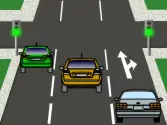
Conduce el vehículo gris, ¿cómo debe actuar, atendiendo a las marcas viales?
You are driving the grey vehicle. How must you act, according to the road markings?
- ADebe girar a la derecha obligatoriamente.You are obliged to turn right.
- BDebe seguir de frente o girar a la derecha.You must go straight on or turn right.
- CDebe seguir de frente obligatoriamente.You are obliged to go straight on.
ExplanationThese road markings painted on the carriageway show the only directions allowed. So the grey vehicle must go straight on or turn right.
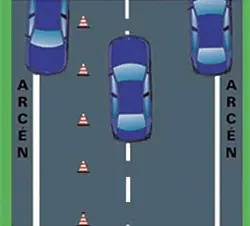
Los conos de la fotografía indican que se ha habilitado…
The cones in the photo show that the road now has...
- AUn carril reversible.a reversible lane.
- BUn carril VAO.an HOV lane (VAO).
- CUn carril adicional circunstancial.a temporary additional lane.
ExplanationThe cones mark out a temporary additional lane: it is set up in the same direction of travel to increase the road's capacity at specific times of heavy traffic, without reversing any direction.
En caso que las indicaciones de las señales parezcan estar en contradicción, ¿a cuál obedeceremos?
If the instructions of signs appear to contradict each other, which one will we obey?
- AA la más restrictiva.The most restrictive one.
- BA la más prioritaria.The one with the highest priority.
- CA la que esté situada más cerca del conductor.The one placed closest to the driver.
ExplanationWhen the instructions of different signs appear to contradict each other, the one with priority prevails according to the order of priority: traffic officers, temporary signs and markers (beacons), traffic lights, road signs and road markings. Only between signs of the same type do you obey the most restrictive one, according to Article 133 of the General Traffic Regulations.
Si su vehículo no dispone de luz de marcha atrás, ¿cómo debe advertir con el brazo que va a dar marcha atrás?
If your vehicle has no reversing light, how must you signal with your arm that you are going to reverse?
- Amoviendo el brazo de arriba abajo.By moving your arm up and down.
- Bbrazo extendido horizontalmente con la palma de la mano hacia atrás.By holding your arm out horizontally with the palm facing backwards.
- Cbrazo doblado hacia arriba, con la mano extendida.By bending your arm upwards with the hand open.
ExplanationUnder Article 109.2.b of the General Traffic Regulations (RGC), reversing is signalled with the reversing light or, if there is none, by holding your arm out horizontally with the palm facing backwards. Moving your arm up and down announces braking, and an arm bent upwards announces moving sideways.
¿Qué significa una marca vial en forma de damero blanco y rojo?
What does a red and white chequered road marking mean?
- AQue no se debe penetrar en la intersección si no se tiene la seguridad de no quedarse detenido en su interior.That you must not enter the junction unless you are sure you will not be held inside it.
- BQue es una zona de frenado de emergencia y prohíbe la parada y el estacionamiento.That it is an emergency braking area and stopping and parking are prohibited.
- CQue es un cebreado y ningún conductor debe entrar con su vehículo en la zona que delimita.That it is a hatched area and no driver may drive a vehicle into the area it marks out.
ExplanationA grid of red and white markings shows where an emergency braking area begins and prohibits stopping and parking.
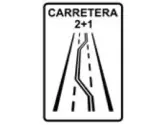
¿Qué indica la señal que se muestra en la imagen?
What does the sign shown in the picture indicate?
- AEl inicio de una autopista con un carril exclusivo para adelantamiento.The start of an autopista (motorway) with a lane only for overtaking.
- BEl inicio de una vía de doble sentido con un solo carril por sentido.The start of a two-way road with a single lane in each direction.
- CEl inicio de una carretera con tres carriles, donde el central se reserva de forma alterna para adelantar.The start of a road with three lanes, where the centre lane is reserved in turn for overtaking.
ExplanationThe sign in the picture shows the start of a 2+1 road, that is, a road with three traffic lanes carrying traffic in both directions. The centre lane is there to make overtaking easier and is reserved in turn for each direction of travel. Generally, the general speed limit for cars on this type of road is 90 km/h.
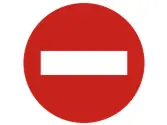
¿Está permitido entrar en una calle con la señalización que se muestra en la imagen?
Is it allowed to enter a street with the signs shown in the picture?
- ANo, porque circulan vehículos en sentido contrario.No, because vehicles are coming in the opposite direction.
- BNo, porque la señal me lo prohíbe.No, because the sign prohibits it.
- CSí, pero respetando la prioridad de los vehículos que circulen en sentido contrario.Yes, but giving priority to vehicles travelling in the opposite direction.
ExplanationThe sign in the question, «No entry», prohibits entry to all types of vehicles. In other words, we cannot enter when we see the sign, but vehicles may come out of that street or road.
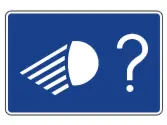
¿Qué debemos hacer a la vista de la señal?
What should we do when we see this sign?
- AApagar las luces de corto alcance.Switch off the dipped headlights.
- BUsar obligatoriamente las luces de corto o largo alcance.Use dipped headlights or main beam, as this is compulsory.
- CMantener encendido el alumbrado de cruce si las circunstancias de visibilidad así lo imponen.Keep the dipped headlights on if visibility conditions require it.
ExplanationThis sign shows the end of the obligation to use dipped headlights imposed by an earlier sign. Even so, if visibility conditions require it, for example at night, we must keep the lights on.
Si en una vía hay una línea continua junto a otra discontinua…
If a road has a solid line next to a broken line…
- ANo se puede cruzar ninguna de las dos líneas.Neither of the two lines may be crossed.
- BEl carril más cercano a la línea discontinua es reversible.The lane closest to the broken line is reversible.
- CSe debe respetar únicamente la línea más cercana al carril por el que se circula.You must only obey the line closest to the lane you are driving in.
ExplanationWhen a road has a solid longitudinal line next to a broken one, under the General Traffic Regulations drivers must only take into account the line closest to the lane they are driving in. This means that the broken line allows some manoeuvres (such as changing lanes), while the solid line prohibits crossing. So only the line nearest to the driver guides what they may do.
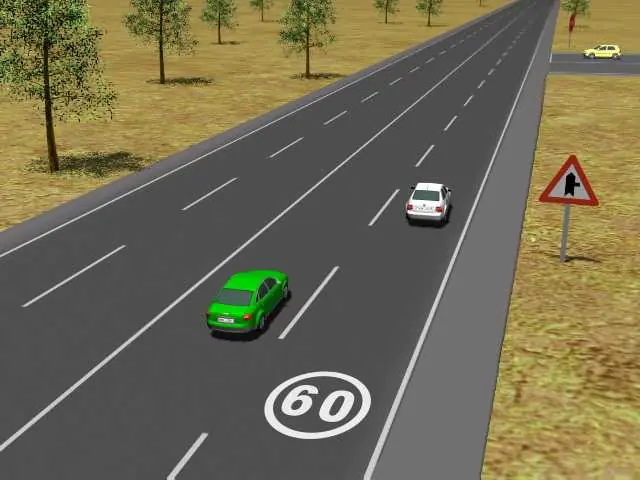
¿En cuál de las siguientes circunstancias termina la limitación de velocidad que indica esta marca vial?
In which of the following situations does the speed limit shown by this road marking end?
- ACuando supere la línea transversal blanca que hay delante de ella.When I pass the white transverse line in front of it.
- BCuando me acerque a la salida del poblado y no haya viviendas cerca.When I approach the edge of the town and there are no houses nearby.
- CCuando encuentre otra señal de velocidad máxima distinta.When I come to another sign with a different maximum speed.
ExplanationThe speed limit road marking (M-6.6 and M-6.7) has the same meaning as the road sign and applies until the next end-of-speed-limit sign, end-of-restrictions sign or another maximum speed sign with a different value. If the lane is marked off, it applies only to that lane.
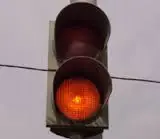
Un semáforo con una o dos luces amarillas alternativamente intermitentes, ¿qué indica?
What does a traffic light with one or two alternately flashing amber lights indicate?
- ADetención obligatoria.Compulsory stop.
- BCalzada cerrada temporalmente al tráfico.Carriageway temporarily closed to traffic.
- CExtremar la precaución y ceder el paso a ambos lados.Take extra care and give way on both sides.
ExplanationOne or two alternately flashing amber lights require you to take extra care and to give way when appropriate, and they do not exempt you from obeying other signs that require you to stop (Annex I of the RGC). A compulsory stop is indicated by flashing red lights.
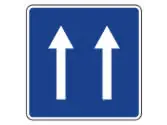
¿Se podrá, a la vista de la señal, efectuar un cambio de dirección a la izquierda?
May you turn left when you see this sign?
- ANo, por prohibirlo la señal.No, because the sign prohibits it.
- BSí, la señal indica que la vía tiene 2 carriles en el mismo sentido.Yes, the sign shows that the road has 2 lanes in the same direction.
- CNo, la señal obliga a seguir de frente.No, the sign requires you to go straight ahead.
ExplanationThe sign in the picture is an information sign: it shows that the carriageway has two lanes for the same direction of traffic. It prohibits driving in the opposite direction, but it does not prohibit turning, so you may turn left by moving into the left-hand lane in good time.
¿Se puede cruzar la línea de borde de la calzada?
May you cross the edge line of the carriageway?
- ASí, cuando la línea es discontinua; no, cuando es continua.Yes, when the line is broken; no, when it is continuous.
- BSí, cuando sea necesario y las circunstancias lo permitan.Yes, when necessary and circumstances allow.
- CNo, está prohibido.No, it is prohibited.
ExplanationAccording to the catalogue of road markings in Annex I of the RGC, carriageway edge lines, continuous or broken, do not change the regulated use of the hard shoulder: a continuous edge line may be crossed occasionally when necessary, for example to move onto the hard shoulder in an emergency.
¿Qué comportamiento exige un semáforo con una o dos luces amarillas alternativamente intermitentes?
What behaviour does a traffic light with one flashing amber light or two alternately flashing amber lights require?
- AObligación de extremar la precauciónYou must take extreme care
- BProximidad de un paso a nivelA level crossing is near
- CDetención inmediata obligatoriaYou must stop immediately
ExplanationUnder the General Traffic Regulations (RGC), one flashing amber light or two alternately flashing amber lights have the same meaning: they require you to take extreme care. This means that the driver must slow down and be ready to stop if necessary, giving way to other vehicles or pedestrians who have right of way. Do not confuse it with two flashing red lights, which indicate a temporary ban on passing (common at level crossings or fire station exits). So it does not require an immediate stop like a red or steady amber light, but alert, defensive driving.
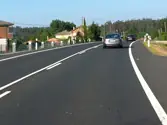
Hay una marca longitudinal continua adosada a otra discontinua, ¿cuál de las dos se debe tener en cuenta?
There is a solid longitudinal marking alongside a broken one. Which of the two must be taken into account?
- ALa marca situada en el lado contrario por el que se circula.The marking on the opposite side to the one you are driving on.
- BLa marca situada en el lado por el que se circula.The marking on the side you are driving on.
- CNinguna de las dos.Neither of them.
ExplanationA marking consisting of a solid longitudinal line alongside a broken one means that drivers must only take into account the line on the side they are driving on. When these markings separate opposite directions of traffic, this does not prevent drivers who have overtaken from returning to their normal position on the carriageway.
En caso que las indicaciones de señales del mismo tipo parezcan estar en contradicción, ¿a cuál obedeceremos?
If the instructions of signs of the same type appear to contradict each other, which one will we obey?
- AA la más restrictiva.The most restrictive one.
- BA la más prioritaria.The one with the highest priority.
- CA la que hayamos visto en último lugar.The one we saw last.
ExplanationIf signs of different types contradict each other, we apply the order of priority between them: 1. Signals and orders from traffic officers. 2. Temporary signs and fixed markers (beacons). 3. Traffic lights. 4. Road signs. 5. Road markings. When the signs are of the same type, the most restrictive one prevails. For example, if we find a Give way road sign and a STOP sign, we will obey the STOP sign because it is the more restrictive.
Si al aproximarnos a una intersección con un semáforo encendido con luz verde, observamos que por la vía transversal se aproxima una ambulancia en servicio de urgencia, ¿qué haremos?
If, as we approach a junction where the traffic light is green, we see an ambulance on an emergency call approaching on the crossing road, what will we do?
- ASeguir circulando normalmente porque el semáforo me permite pasar.Carry on normally, because the traffic light allows me to go.
- BDetenernos para facilitar el paso a la ambulancia.Stop to let the ambulance through.
- CDetenernos sólo si la ambulancia se aproxima por la derecha.Stop only if the ambulance is approaching from the right.
ExplanationThe correct answer is to stop to let the ambulance through because, even if the light is green, priority vehicles on an emergency call have priority and it is our responsibility to give way to them so that they can reach their destination quickly.
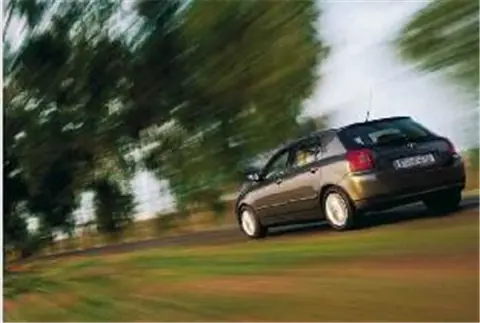
Al circular a mayor velocidad...
When driving at higher speed...
- Ase perciben peor las señales de tráfico.traffic signs are harder to see.
- Bse perciben mejor las señales de tráfico.traffic signs are easier to see.
- Cse puede ver y analizar mejor lo que ocurre alrededor.you can see and analyse what is happening around you better.
ExplanationDriving at higher speed makes driving more demanding. You need to anticipate traffic situations earlier and pay more attention to seeing signs correctly, because they go past faster and you may easily not have time to identify them. There is also the tunnel effect: you gradually lose what is happening at the edges of your vision and only see the centre of the road clearly.
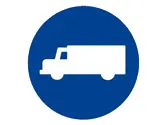
¿Un turismo puede circular por una calzada así señalizada?
Can a car use a carriageway marked like this?
- ANo, esta señal solo permite el acceso a camiones.No, this sign only allows lorries in.
- BSí.Yes.
- CNo, esta señal solo permite el acceso a camiones, furgones y furgonetas de más de 3500 kg.No, this sign only allows in lorries and vans over 3,500 kg.
ExplanationThis sign requires drivers of lorries and vans to use the carriageway marked like this, but it does not prohibit other vehicles from using it, so a car may use this carriageway.
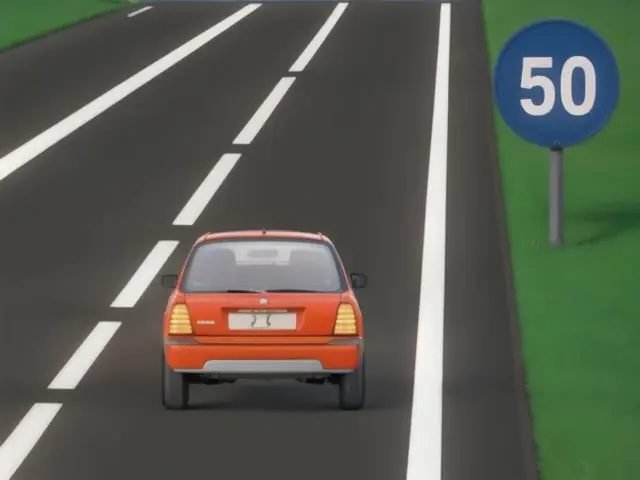
Si el vehículo de la imagen circula a 80 km/h, ¿respeta la señal?
If the vehicle in the picture is travelling at 80 km/h, is it obeying the sign?
- ANo, debería circular como máximo a 50 km/h.No, it should be travelling at no more than 50 km/h.
- BSí.Yes.
- CNo.No.
ExplanationThe round blue sign with a number is a minimum speed sign: it requires you to drive at least at the speed shown, in this case 50 km/h. A vehicle travelling at 80 km/h obeys it, as long as it does not exceed the maximum limit set for that road.
All topics
- Definitions
- Documents and penalty points
- The driver's condition
- Duties of drivers and pedestrians
- Vehicle safety devices
- Vehicle controls and equipment
- Vehicle lights and horn
- The road and its lanes
- Speed and distances
- Manoeuvres
- Right of way
- Carrying passengers and loads
- Driving safely in difficult conditions
- Vehicle mechanics and maintenance
- Road accidents and first aid
- Defensive and eco-driving
Independent app: not affiliated with or endorsed by the DGT (Spain's Directorate-General for Traffic) or the Ministry of the Interior. The official exam is booked with the DGT and taken at its test centres. The questions here are practice material; the DGT's official question bank is not public.
Basado en datos de la Agencia Estatal Boletín Oficial del Estado (https://www.boe.es). Textos consolidados de carácter meramente informativo. La AEBOE no patrocina ni respalda este sitio.
Parte de las preguntas procede de los tests de la revista «Tráfico y Seguridad Vial» de la DGT, reproducidos con indicación de la fuente.