
DGT test · 1,397 questions
Traffic signs, markings and signals · Page 25 of 28
Road signs, road markings, traffic lights, police signals and temporary markings: what they mean and which one wins when they disagree. The topic with the most questions in the bank.
Questions in this topic, with answers
1,397 questions, 50 per page, with the correct answer and the explanation. Page 25 of 28.
Un agente que emite un toque de silbato largo y sostenido, ¿qué indica?
What does a traffic officer giving one long, sustained whistle blast indicate?
- ADetención.Stop.
- BReanudar la marcha.Move off again.
- CExtremar la precaución.Take extra care.
ExplanationOne long whistle blast means move off again. A series of short, frequent whistle blasts orders vehicles to stop.
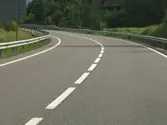
Cuando la separación entre los trazos de la línea longitudinal discontinua es sensiblemente más corta que en el caso general, ¿qué indica?
When the gaps between the dashes of a broken longitudinal line are noticeably shorter than normal, what does this indicate?
- AQue se trata de un carril especial.That it is a special lane.
- BQue se aproxima a una marca longitudinal continua o a un tramo de especial peligro.That you are approaching a solid longitudinal marking or a particularly dangerous stretch.
- CQue es un carril reversible.That it is a reversible lane.
ExplanationWhen the gaps between the dashes of a broken longitudinal line are noticeably shorter than normal, this may indicate that you are approaching a stretch of road with a special risk or a solid longitudinal marking.
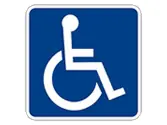
Un turismo que lleve esta señal de minusválido, ¿puede circular por un carril VAO?
May a car displaying this disabled person's sign use an HOV (VAO) lane?
- ANo, salvo que tenga una autorización especial del titular de la vía.No, unless it has special authorisation from the road owner.
- BSolo si está ocupado por dos o más personas.Only if there are two or more people in it.
- CSí,aun cuando solo lo ocupe su conductor.Yes, even if only the driver is in it.
ExplanationUnder Article 35.2.a) of the General Traffic Regulations (RGC), HOV (VAO) lanes may be used, even when only the driver is in the vehicle, by authorised vehicles (motorcycles, cars and adaptable mixed-use vehicles) that display sign V-15 or the parking card for people with disabilities and reduced mobility.
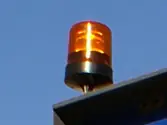
Los conductores de vehículos especiales que están obligados a utilizar la señal V-2, ¿cuándo la utilizarán?
Drivers of special vehicles that are required to use signal V-2: when must they use it?
- ATanto de día como de noche.Both by day and at night.
- BSolo de día.Only by day.
- CSolo de noche.Only at night.
ExplanationSignal V-2 must be switched on independently of the other lights and must work both by day and at night when driving on public roads. This light shows the position of a vehicle that is providing a service or doing an activity or work, whether stopped, parked or moving at no more than 40 km/h. It is also used by vehicles under special transport arrangements, pilot or escort vehicles and military convoys. If the V-2 light breaks down, they must use the dipped headlights together with the hazard warning lights.
Un peatón que cruza por un paso regulado por semáforo con su luz verde peatonal:
A pedestrian crossing at a crossing controlled by traffic lights while the pedestrian light is green:
- ADebe ceder el paso a los coches.Must give way to cars.
- BTiene preferencia; el conductor que gire debe cederle el paso.Has priority; a driver who is turning must give way to them.
- CNo tiene ninguna preferencia.Has no priority at all.
ExplanationWhen the pedestrian light is green, the pedestrian has priority; a driver turning towards that crossing must give way to them.
En una zona de obras hay una señal direccional provisional. ¿Qué indica?
In a roadworks area there is a temporary directional panel. What does it indicate?
- AIndica la existencia de una curva y su dirección en la zona de obras.It indicates a bend and its direction in the roadworks area.
- BProhíbe el paso e indica el sentido de la circulación.It prohibits passing and indicates the direction of traffic.
- CAdvierte del peligro debido a las obras.It warns of danger due to the roadworks.
ExplanationUnder Annex I of the General Traffic Regulations, the temporary directional panel prohibits passing and also shows the direction of traffic. Permanent directional panels, on the other hand, mark the line of a bend.
Una línea amarilla continua junto al borde de la calzada, ¿qué significa?
What does a continuous yellow line along the edge of the carriageway mean?
- AQue la parada está prohibida.That stopping is prohibited.
- BQue el estacionamiento está prohibido.That parking is prohibited.
- CQue tanto la parada como el estacionamiento están prohibidos.That both stopping and parking are prohibited.
ExplanationA continuous yellow line means that both stopping and parking are prohibited. A broken yellow line, on the other hand, only prohibits parking.
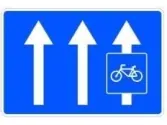
A la vista de la señal, ¿qué indica sobre el carril señalado?
Given the sign, what does it indicate about the lane shown?
- AEl carril está reservado a la circulación de ciclos y los demás usuarios no pueden usarlo.The lane is reserved for cycles and other road users may not use it.
- BLos ciclos pueden usar el carril, pero otros vehículos también pueden circular en él.Cycles may use the lane, but other vehicles may also drive in it.
- CEl carril está destinado únicamente a adelantamientos de vehículos lentos.The lane is only for overtaking slow vehicles.
ExplanationSign S-65a indicates that, on a one-way carriageway, the lane where the sign is placed is reserved exclusively for cycles. Any other vehicle is prohibited from using this lane. The arrows on the sign show the number of lanes on the carriageway, helping drivers to position themselves correctly and respect the reserved lane.
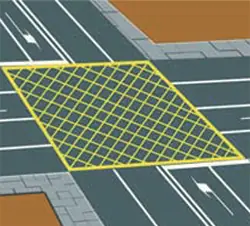
Una cuadrícula de marcas amarillas pintada en el suelo indica...
A grid of yellow markings painted on the road surface indicates...
- Aque no se puede franquear la intersección.that you may not go through the junction.
- Bque no se debe entrar en la intersección si se puede quedar detenido en ella, obstaculizando la circulación.that you must not enter the junction if you might end up stopped in it, blocking traffic.
- Cque el estacionamiento está prohibido.that parking is prohibited.
ExplanationThe yellow grid marks a junction area that must be kept clear: it prohibits entering the junction if, because of the traffic, the vehicle might end up stopped inside it, blocking crossing traffic.
Cuando exista aparente contradicción entre dos señales, ¿cuál de ellas tendremos que respetar?
When two signs seem to contradict each other, which one must we obey?
- ALa más restrictiva.The more restrictive one.
- BLa de mayor prioridad.The one with higher priority.
- CNinguna de las dos anteriores.Neither of the above.
ExplanationUnder Article 133 of the General Traffic Regulations (RGC), if two signs seem to contradict each other, the one with higher priority prevails, in this order: traffic officers, temporary signs, traffic lights, road signs and road markings. Only when both are of the same type do you obey the more restrictive one.
¿Qué indica una luz roja fija de balizamiento colocada en la calzada?
What does a steady red beacon light placed on the carriageway indicate?
- ALa calzada está totalmente cerrada al tráfico.The carriageway is completely closed to traffic.
- BProhíbe el paso e informa, además, acerca del sentido de la circulación.It prohibits passing and also shows the direction of traffic.
- CProhíbe el paso a través de la línea imaginaria que las une.It prohibits passing across the imaginary line that joins the lights.
ExplanationAccording to Annex I of the General Traffic Regulations (section 3.1.1), a steady red light is a delimiting device showing that the carriageway is completely closed to traffic. Prohibiting passage across the imaginary line joining them is the role of yellow lights, and it is the temporary direction panel that also shows the direction of traffic.
Las marcas blancas discontinuas más anchas de lo normal que separan el carril de la derecha significan que...
Broken white lines that are wider than normal and separate the right-hand lane mean that...
- AEs un carril solo para salir de la autopista o de la autovía.It is a lane only for leaving the motorway (autopista) or dual carriageway (autovía).
- BEs un carril especial.It is a special lane.
- CDichas marcas separan la calzada del arcén.These markings separate the carriageway from the hard shoulder.
ExplanationUnder the road-marking catalogue (RD 465/2025), a wide broken line (M-1.6 and M-1.7) separates a special lane from the others: a speed-change (acceleration or deceleration) lane, a weaving lane, a lane reserved for certain vehicles or an additional lane.
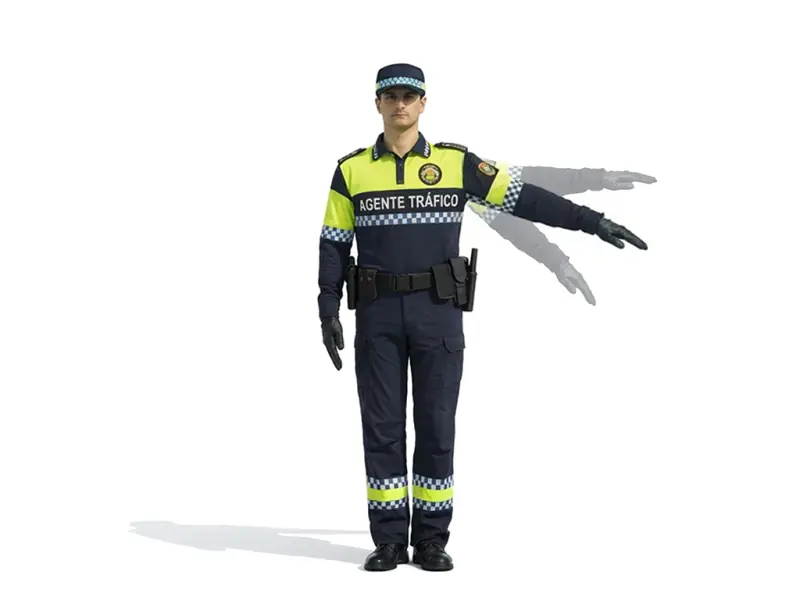
Un agente le hace señas moviendo el brazo alternativamente de arriba abajo, ¿qué debe hacer?
A traffic officer signals to you by moving an arm up and down repeatedly. What must you do?
- AGirar hacia el lado que indica el brazo.Turn towards the side the arm is pointing to.
- BDisminuir la velocidad.Reduce speed.
- CDetenerse inmediatamente a la derecha.Stop immediately on the right.
ExplanationA traffic officer moving an arm up and down requires you to reduce your vehicle's speed. This applies to drivers approaching the officer from the side of the arm making the signal, perpendicular to that arm. Do not confuse this with an officer swinging a red or yellow light, which requires the road users the light is directed at to stop.
Si un agente realiza un pitido largo, ¿qué indica?
If a traffic officer gives one long whistle blast, what does it indicate?
- AQué nos detengamos.That you must stop.
- BQué reanudemos la marcha.That you must move off again.
- CQué moderemos la velocidad.That you must slow down.
ExplanationMoving off again is signalled with one long whistle blast, and stopping vehicles with short, frequent whistle blasts.
Si un agente realiza con su silbato una serie de toques cortos y frecuentes, ¿qué significa?
If a traffic officer gives a series of short, frequent blasts on the whistle, what does it mean?
- AQue podemos reanudar la marcha.That you may move off again.
- BQue tenemos que detenernos.That you must stop.
- CQue podemos pasar con precaución.That you may go through with care.
ExplanationUnder the General Traffic Regulations, a series of short, frequent whistle blasts from the officer orders vehicles to stop. One long blast, on the other hand, orders them to move off again.
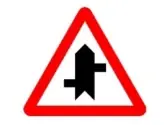
A la vista de la señal P1e, debe tener en cuenta …
Given sign P-1e, you must bear in mind...
- Aque debemos ceder el paso a los accesos, tanto a los que se incorporan por la derecha como por la izquierda.that we must give way to the side accesses, both those joining from the right and those from the left.
- Bque la vía puede presentar frecuentes atascos o retenciones.that the road may often have traffic jams or tailbacks.
- Cque tenemos preferencia de paso frente a los accesos de la derecha e izquierda.that we have right of way over the accesses on the right and on the left.
ExplanationThe sign in the picture means 'Stretch with direct accesses'. It warns of danger because you are approaching a stretch with several direct accesses onto the road, and users coming from those accesses must give way.
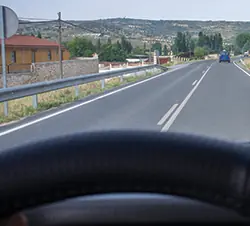
Si en una vía existe una línea longitudinal continua adosada a otra discontinua…
If a road has a solid longitudinal line running alongside a broken one...
- ANingún vehículo que circule por la vía podrá atravesar ninguna de las dos líneas.no vehicle on the road may cross either of the two lines.
- BEl carril que tiene más cercana la línea discontinua es reversible.the lane closest to the broken line is reversible.
- CDebemos tener en cuenta solo la línea más cercana al carril por el que circulamos.we must only take into account the line closest to the lane we are driving in.
ExplanationWhen a solid line runs alongside a broken one, each driver only takes into account the one nearest their lane: if it is broken, they may cross it; if it is solid, they may not.
Si un agente de tráfico ordena algo que contradice a un semáforo en verde:
If a traffic officer gives an instruction that contradicts a green traffic light:
- ASe obedece al semáforo.You obey the traffic light.
- BSe obedece al agente, cuyas indicaciones prevalecen.You obey the officer, whose instructions take precedence.
- CSe elige la opción más cómoda.You choose the most convenient option.
ExplanationOfficers' signals take precedence over any other sign, including traffic lights.
Te encuentras con un paso de peatones y tienes un semáforo con luz amarilla intermitente, ¿qué debes hacer?
You come to a pedestrian crossing and have a flashing amber traffic light. What should you do?
- ADetenerme cuando sea necesario y ceder el paso a los peatones.Stop when necessary and give way to pedestrians.
- BDetenerme, porque es un paso para peatones con semáforo.Stop, because it is a pedestrian crossing with traffic lights.
- CPasar, porque el semáforo no está amarillo fijo.Go, because the light is not steady amber.
ExplanationA flashing amber light means you must take extra care and, where appropriate, give way; in other words, give way to pedestrians if there are any.
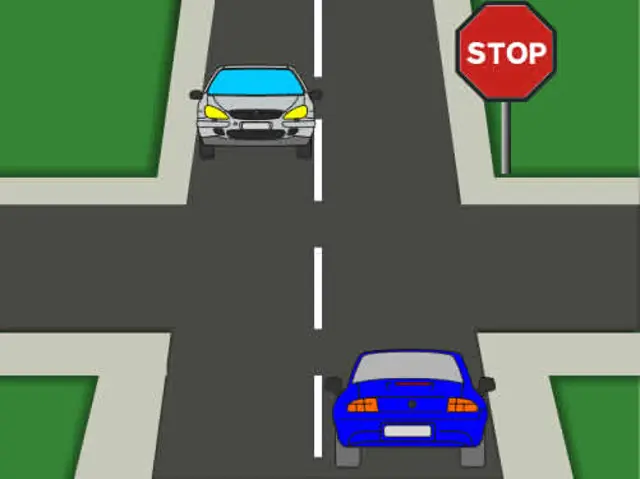
El vehículo azul quiere girar a la derecha. ¿Qué le obliga la señal STOP?
The blue vehicle wants to turn right. What does the STOP sign require it to do?
- ADetenerse y ceder el paso a los vehículos que circulan por la vía que tiene prioridad.Stop and give way to vehicles on the road with priority.
- BNo le obliga a nada.It does not require it to do anything.
- CDetenerse siempre.Always stop.
ExplanationThe STOP sign is not on the blue vehicle's right before the junction, but on the other side of the junction, at the corner of the crossing road, and it controls those arriving on that road. When turning right, the blue vehicle does not approach it, so it does not require it to do anything.
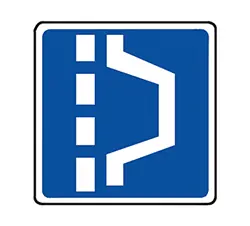
Esta señal indica la situación de un lugar donde se puede...
This sign shows the location of a place where you can...
- Aestacionar el vehículo el tiempo que se desee.park the vehicle for as long as you like.
- Brealizar una parada para descansar.stop to rest.
- Capartar el vehículo en caso de emergencia para dejar libre el paso.pull the vehicle over in an emergency to leave the way clear.
ExplanationThis is sign S-34, emergency lay-by: it shows a place where you can pull the vehicle over in an emergency to leave the way clear. It is not a parking or rest area. S-34a marks a lay-by in a tunnel with an emergency telephone.
En la vía por la que usted circula existen semáforos sin flecha con indicaciones distintas a la derecha y a la izquierda. Si usted va a seguir de frente, ¿a qué semáforo debe obedecer?
On the road you are driving along there are traffic lights without arrows showing different signals on the right and on the left. If you are going to go straight on, which traffic light must you obey?
- AAl de la izquierda.The one on the left.
- BAl de la derecha.The one on the right.
- CAl que emita el mensaje más restrictivo.The one showing the more restrictive message.
ExplanationUnder Article 132.3 of the General Traffic Regulations (RGC), if there are traffic lights showing different signals on the right and on the left, those who intend to go straight on or turn left must obey only the one immediately to their left.
¿Qué indican las marcas viales amarillas por obras?
What do yellow road markings for roadworks indicate?
- ASignifican lo mismo que sus equivalentes cuando no hay obras.They mean the same as their equivalents when there are no roadworks.
- BSignifican que solo las tenemos que obedecer cuando exista el encargado de la obra.They mean we only have to obey them when the person in charge of the works is present.
- CSignifican que son orientativas y no obligan a los conductores.They are only a guide and are not binding on drivers.
ExplanationYellow road markings on a stretch with roadworks mean the same as their white equivalents and are just as binding. Under the 2025 catalogue, new markings painted during the works are yellow, and white markings that still apply may be kept.
Si pretendemos cambiar de dirección a la izquierda y hay distintas señales verticales a la derecha y a la izquierda, ¿a cual obedeceremos?
If you intend to turn left and there are different upright signs on the right and on the left, which do you obey?
- AA la de la derecha.The one on the right.
- BA la de la izquierda.The one on the left.
- CA ninguna de las dos.Neither of them.
ExplanationIf there are signs with different instructions on the right and on the left, vehicles that intend to turn left or go straight on must obey only the signs immediately on their left.
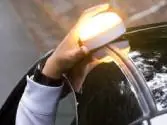
La señal luminosa de preseñalizacion de peligro lo situaremos ...
The luminous hazard warning device should be placed...
- AA 100 m de distancia del vehículo inmovilizado.100 m away from the broken-down (immobilised) vehicle.
- BEn la parte más baja posible del vehículo inmovilizado.On the lowest possible part of the broken-down vehicle.
- CEn la parte más alta posible del vehículo inmovilizado garantizado su máxima visibilidadOn the highest possible part of the broken-down vehicle, so that it is as visible as possible.
ExplanationThe V-16 hazard warning device is an approved amber-yellow light with geolocation that runs on its own power supply (batteries). It must be placed on the highest part of the immobilised vehicle, so that it is as visible as possible. Today the V-16 is the only legal way to signal an immobilised vehicle or an obstacle on the road; warning triangles are no longer used.
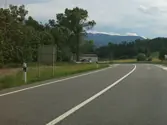
¿Podemos en algún caso circular por el lado izquierdo de una línea continua?
May we ever drive on the left-hand side of a continuous line?
- ANo, en ningún caso.No, never.
- BSí, si la vía está dentro de poblado.Yes, if the road is in a built-up area.
- CSí, si la vía es de sentido único.Yes, if the road is one-way.
ExplanationWe may not drive to the left of a continuous line when the marking separates the two directions of traffic, but we may do so if the road is one-way.
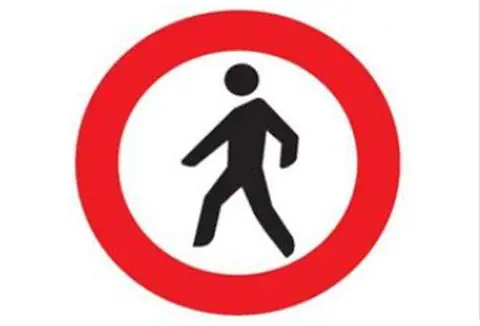
¿Qué significa esta señal?
What does this sign mean?
- AProhibida la entrada a peatones.No entry for pedestrians.
- BProhibida la entrada a los menores de 18 años.No entry for under-18s.
- CProhibida la entrada a todos los varones.No entry for all men.
ExplanationThis is the ‘No entry for pedestrians’ sign (R-116): it prohibits pedestrians from using the road at whose entrance it is placed. It has nothing to do with people's age or sex.
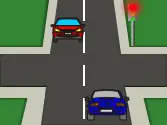
Si desea cambiar de dirección a la derecha, ¿le afecta el semáforo?
If you want to turn right, does the traffic light apply to you?
- ANo, el semáforo sólo me afecta si quiero seguir de frente.No, the traffic light only applies to me if I want to go straight on.
- BSí, pero solo tendré que detenerme si cruzan peatones.Yes, but I will only have to stop if pedestrians are crossing.
- CSí, tendré que esperar a que cambie a verde.Yes, I will have to wait for it to turn green.
ExplanationA steady (non-flashing) red light prohibits passing. While it is on, vehicles must not go past the traffic light or the nearest stop line before it, if there is one. If the traffic light is inside the junction or on the opposite side of it, vehicles must not enter the junction or go past the stop line before it, if there is one.
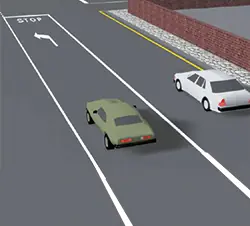
¿Debe el conductor del turismo de color blanco respetar la señal de stop cuando llegue al cruce?
Must the driver of the white car obey the STOP sign when reaching the junction?
- ASí, debe respetar las marcas viales existentes.Yes, they must obey the road markings there.
- BNo, porque la señal horizontal solo es para los que giren a la izquierda.No, because the road marking only applies to those turning left.
- CSí, pero solo si sigue de frente.Yes, but only if they go straight on.
ExplanationRoad markings only apply to those driving in the lane on which they are painted: the STOP with an arrow only affects the left-turn lane, so the white car, which is not using it, does not have to stop.
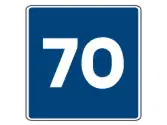
A la vista de la señal sabemos que...
From this sign, we know that...
- AEstá prohibido circular a más de 70 km/h.driving faster than 70 km/h is prohibited.
- BComo mínimo tenemos que circular a 70 km/h.we must drive at a minimum of 70 km/h.
- CEs recomendable circular como máximo a 70 km/h.it is advisable to drive at no more than 70 km/h.
ExplanationThe sign recommends driving at no more than 70 km/h, even when weather, environmental, road and traffic conditions are favourable.
¿Qué nos indica un conductor que mueve el brazo alternativamente de arriba a abajo con movimientos cortos y rápidos?
What is a driver telling us by moving an arm up and down with short, quick movements?
- AQue va a cambiar de dirección a la izquierda.That they are going to turn left.
- BLa intención de inmovilizar el vehículo o frenar su marcha.That they intend to bring the vehicle to a standstill or slow down.
- CLa intención de efectuar marcha hacia atrás.That they intend to reverse.
ExplanationMoving the arm up and down with short, quick movements warns that you intend to bring the vehicle to a standstill or to slow down considerably (article 109.2 of the RGC). Reversing is shown with the arm held horizontally and the palm facing backwards.
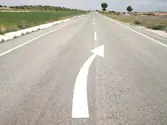
¿Qué significa esta marca vial?
What does this road marking mean?
- AFlecha de retorno.«Move back in» arrow.
- BFin de carril.End of lane.
- CObligación de girar a la derecha.Obligation to turn right.
ExplanationThis road marking, placed on the centre line of a carriageway, shows that you are approaching a continuous line that prohibits driving to its left, so every driver must move as soon as possible into the lane to the right of the arrow.
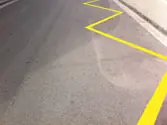
Esta marca amarilla prohíbe...
This yellow marking prohibits...
- Asólo parar.only stopping.
- Bsólo estacionar.only parking.
- Cparar y estacionar.stopping and parking.
ExplanationA yellow zigzag road marking at the edge of the carriageway marks a place where parking is prohibited for vehicles in general because it is reserved for a special use, such as a bus stop or a loading and unloading area. Stopping is permitted.

Esta señal es de prohibición de entrada para...
This sign prohibits entry to...
- ASolo los vehículos de motor.Motor vehicles only.
- BToda clase de vehículos incluidas las bicicletas.All kinds of vehicles, including bicycles.
- CSolo para los vehículos automóviles.Motor cars only.
ExplanationThe sign prohibits entry to all kinds of vehicles, including bicycles.
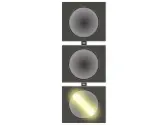
¿Qué indica el semáforo intermitente?
What does the flashing traffic light show?
- AQue tenemos la obligación de detenernos.That we must stop.
- BQue deben detenerse los autobuses y taxis.That buses and taxis must stop.
- CQue pueden pasar autobuses tranvías y taxis.That buses, trams and taxis may go through.
ExplanationWhen the traffic light with a white bar on a black background is flashing, it means stop, in the same way as a steady amber light, for vehicles using a reserved lane, for example for buses and taxis, and it refers only to that lane.
Un semáforo con una luz amarilla intermitente, ¿qué significa?
What does a traffic light with a flashing amber light mean?
- AExtremar la precaución y, en su caso, ceder el paso.Take extra care and, where appropriate, give way.
- BDetenerse siempre, como si fuera una luz roja.Always stop, as if it were a red light.
- CQue se tiene prioridad de paso sobre los demás vehículos.That you have right of way over other vehicles.
ExplanationUnder section 4.2.d) of Annex I of the General Traffic Regulations (RGC), a flashing amber light requires you to take extra care and, where appropriate, give way according to the other signs or the general priority rules. It also does not exempt you from obeying other signs that require you to stop.
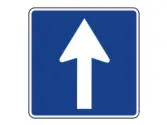
¿Está permitido cambiar de dirección a la vista de la señal?
Is turning allowed when you see this sign?
- ASi, tanto a la derecha como a la izquierda.Yes, both right and left.
- BNo, ya que la señal obliga a seguir de frente.No, because the sign requires you to go straight ahead.
- CSi, tanto de dirección como de sentido.Yes, both turning and making a U-turn.
ExplanationThe sign shows that the carriageway is one-way. This sign allows turning; what is prohibited is making a U-turn.
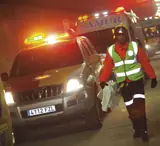
¿Debe facilitar el paso a una ambulancia que utiliza la señal luminosa pero no la señal acústica?
Must you make way for an ambulance that is using its flashing lights but not its siren?
- ANo, porque no circula en servicio urgente.No, because it is not on an emergency call.
- BSí, porque está advirtiendo que circula en servicio urgente.Yes, because it is warning that it is on an emergency call.
- CNo, porque si no utiliza la señal acústica se debe a que tiene suficiente espacio para pasar.No, because if it is not using the siren, it has enough room to get past.
ExplanationA priority vehicle on an emergency call may use only the light signal when the siren is not needed (Article 68 of the General Traffic Regulations, RGC). So even if the siren is not sounding, the light shows that it is on an emergency call and you must make way for it, moving to the right or stopping if necessary.
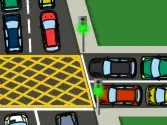
¿Cómo actuará en esta situación a la vista del semáforo?
Given the traffic light, what will you do in this situation?
- AContinuar de frente ya que el semáforo esta verde.Go straight on, because the light is green.
- BDetener el vehículo sólo en el caso de no tener la prioridad.Stop the vehicle only if you do not have priority.
- CDetener el vehículo antes de entrar en la intersección.Stop the vehicle before entering the junction.
ExplanationYou must not enter the junction, even if you have right of way, if you can foresee that you risk not getting across it and being stuck inside it, blocking or obstructing cross traffic.
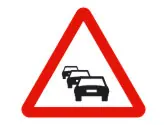
Esta señal indica peligro por la proximidad de un tramo...
This sign warns of danger because you are approaching a stretch...
- Apor donde sólo pueden circular turismos.that only cars may use.
- Bcon atascos o retenciones.with traffic jams or queues.
- Cdonde no es obligatorio guardar la distancia de seguridad.where it is not compulsory to keep a safe distance.
ExplanationThe sign in the question warns of danger because you are approaching a stretch of road where traffic is stopped or slowed down by congestion.
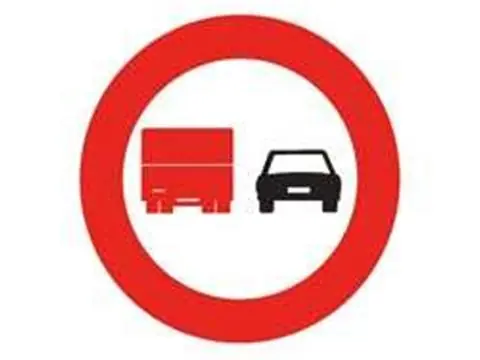
Circula con un turismo, ¿le prohíbe esta señal efectuar un adelantamiento?
You are driving a car. Does this sign prohibit you from overtaking?
- ANo.No.
- BNo, la señal sólo prohíbe que se adelante a los camiones por la derecha.No, the sign only prohibits overtaking lorries on the right.
- CSí, la señal prohíbe adelantar a todos los vehículos en general y especialmente a los camiones.Yes, the sign prohibits overtaking any vehicle, and especially lorries.
ExplanationThis is the ‘no overtaking for lorries’ sign: it only prohibits lorries with a maximum authorised mass of more than 3,500 kg from overtaking. A car may overtake normally, if the other conditions are met.

Los vehículos prioritarios que circulen en servicio urgente advertirán su presencia...
Priority vehicles on an emergency call must warn of their presence...
- Amediante la utilización simultánea de la señal luminosa y la señal acústica.by using the light signal and the sound signal at the same time.
- Bsolamente con la señal acústica.only with the sound signal.
- Ccon la utilización simultánea de la señal de emergencia y la señal acústica.by using the hazard warning lights and the sound signal at the same time.
ExplanationUnder Article 68.2 of the General Traffic Regulations (RGC), priority vehicles on an emergency call warn of their presence by using the light signal and the special sound signal device at the same time. They must use the light signal alone when leaving out the sound signals poses no danger to other road users.
¿Cuál es la conducta correcta ante un semáforo con luz amarilla fija encendida?
What is the correct behaviour at a traffic light with a steady amber light on?
- AAcelerar para cruzar antes de que cambie a roja.Speed up to cross before it turns red.
- BDetenerse como si fuera una luz roja, salvo que estemos tan cerca que la frenada resulte peligrosa.Stop as if it were a red light, unless we are so close that braking would be dangerous.
- CContinuar porque la luz fija da prioridad sobre los peatones.Carry on, because the steady light gives priority over pedestrians.
ExplanationA steady amber light requires you to stop under the same conditions as a red light, unless the vehicle is so close that braking would create a risk of a rear-end collision.
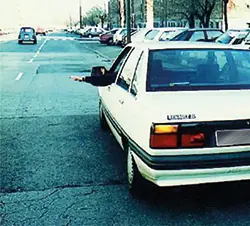
Las señales realizadas con el brazo por los conductores, ¿son válidas?
Are arm signals made by drivers valid?
- ASolo cuando se vean bien.Only when they can be clearly seen.
- BSolo cuando se utilicen de día.Only when used during the day.
- CSolo cuando se utilicen en poblado.Only when used in built-up areas.
ExplanationArm signals replace or supplement the indicators and are valid as long as they are perceptible, that is, other road users can see them clearly, by day or by night.
Un turismo, ¿puede circular por un carril BUS señalizado con una línea longitudinal continua?
May a car drive in a BUS lane marked with a continuous longitudinal line?
- ASí, para girar a la derecha.Yes, to turn right.
- BNo.No.
- CSí, cuando el carril se encuentra en una vía urbana.Yes, when the lane is on a road in a built-up area.
ExplanationLanes with the word BUS or TAXI painted on them and marked off by a continuous longitudinal line are reserved, permanently or temporarily, for buses or taxis respectively to drive, stop or park. Cars are prohibited from driving, stopping or parking in them.
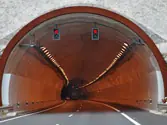
Si a la entrada de un túnel hay un semáforo en rojo, ¿qué debe hacer?
If there is a red traffic light at the entrance to a tunnel, what must you do?
- AContinuar la marcha con precaución.Continue with care.
- BNo entrar en el túnel.Not enter the tunnel.
- CPasar circulando a 50 kilómetros por hora como máximo.Drive through at no more than 50 kilometres per hour.
ExplanationA steady (non-flashing) red light prohibits passing. While it is on, vehicles must not go past the traffic light or, if there is one, the nearest stop line before it.
¿Qué utiliza el sistema de reconocimiento de señales de tráfico del vehículo para leer las señales verticales?
What does a vehicle's traffic sign recognition system use to read road signs?
- AUna cámara o un sensor situado detrás del espejo retrovisor.A camera or sensor located behind the rear-view mirror.
- BSiempre utiliza los datos del navegador para mostrar la información.It always uses sat nav data to display the information.
- CEste sistema solo muestra información sobre las señales viales pintadas en la calzada.This system only shows information about road markings painted on the carriageway.
ExplanationTraffic sign recognition systems use a camera, usually located behind the interior rear-view mirror, which picks up road signs and displays their information on the dashboard. They are an aid: the driver is still responsible for obeying the signs.
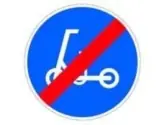
Tras esta señal, los vehículos de movilidad personal:
After this sign, personal mobility vehicles:
- ADeben continuar por la vía reservada y obligatoria.Must continue on the reserved, compulsory route.
- BYa no están obligados a circular por la vía reservada.No longer have to use the reserved route.
- CSe prohíbe su circulación por la vía.Are prohibited from using the road.
ExplanationThe sign in the picture shows the end of the route that is reserved for, and compulsory for, personal mobility vehicles.
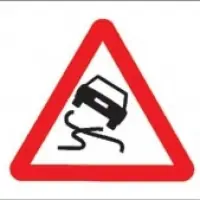
¿De qué advierte la señal de pavimento deslizante?
What does the slippery road sign warn you about?
- ADe la proximidad de un tramo con niebla frecuente.A stretch ahead where fog is frequent.
- BDe la proximidad de un tramo con fuertes rachas de viento.A stretch ahead with strong gusts of wind.
- CDe la proximidad de una zona cuyo pavimento puede resultar deslizante.An area ahead where the road surface may be slippery.
ExplanationSign P-19, ‘Slippery road’, warns that you are approaching an area of the carriageway where the surface may be slippery. Fog is warned of by P-33 ‘Reduced visibility’, wind by P-29 ‘Crosswind’ and frequent ice or snow by P-34.
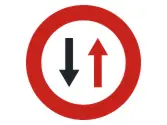
¿Qué indica esta señal en un paso estrecho?
What does this sign at a narrow passage show?
- AQue tienen prioridad los vehículos que circulan en sentido contrario.That vehicles coming in the opposite direction have priority.
- BQue tienen prioridad los vehículos que se encuentran la señal en su sentido.That vehicles facing the sign in their direction have priority.
- CQue existe un estrechamiento de la calzada por obras.That the carriageway narrows because of roadworks.
ExplanationThis sign, placed at the entrance to a narrowing of the carriageway, shows that priority is for vehicles coming in the opposite direction.
All topics
- Definitions
- Documents and penalty points
- The driver's condition
- Duties of drivers and pedestrians
- Vehicle safety devices
- Vehicle controls and equipment
- Vehicle lights and horn
- The road and its lanes
- Speed and distances
- Manoeuvres
- Right of way
- Carrying passengers and loads
- Driving safely in difficult conditions
- Vehicle mechanics and maintenance
- Road accidents and first aid
- Defensive and eco-driving
Independent app: not affiliated with or endorsed by the DGT (Spain's Directorate-General for Traffic) or the Ministry of the Interior. The official exam is booked with the DGT and taken at its test centres. The questions here are practice material; the DGT's official question bank is not public.
Basado en datos de la Agencia Estatal Boletín Oficial del Estado (https://www.boe.es). Textos consolidados de carácter meramente informativo. La AEBOE no patrocina ni respalda este sitio.
Parte de las preguntas procede de los tests de la revista «Tráfico y Seguridad Vial» de la DGT, reproducidos con indicación de la fuente.