
DGT test · 1,397 questions
Traffic signs, markings and signals · Page 17 of 28
Road signs, road markings, traffic lights, police signals and temporary markings: what they mean and which one wins when they disagree. The topic with the most questions in the bank.
Questions in this topic, with answers
1,397 questions, 50 per page, with the correct answer and the explanation. Page 17 of 28.
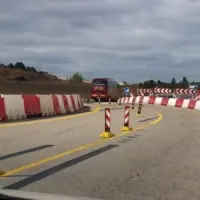
¿De qué color son las marcas viales que señalizan tramos de obras?
What colour are the road markings used on roadworks sections?
- ARojoRed.
- BAmarilloYellow.
- CBlancoWhite.
ExplanationYellow road markings are used on roadworks sections, and they stay in place only for as long as the works they mark last. They are removed once the work on the road is finished.
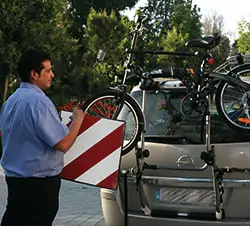
Si circula con un turismo en el que sobresale la carga por su parte trasera, ¿está obligado a colocar la señal de la imagen?
If you are driving a car with a load sticking out at the back, must you fit the sign shown in the picture?
- ANo, porque un turismo no transporta exclusivamente mercancías.No, because a car does not carry goods exclusively.
- BSolo se colocará cuando la carga sobresalga por la parte delantera.It is only fitted when the load sticks out at the front.
- CSí; deberá colocarse en la parte posterior de la carga.Yes; it must be placed at the rear end of the load.
ExplanationAny load sticking out at the back must be marked at its end with the V-20 panel, whatever the vehicle, including a car. Its purpose is to make the overhang visible to other drivers.
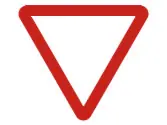
¿A qué obliga esta señal?
What does this sign require?
- AA detenerse.You must stop.
- BA ceder el paso a todos los vehículos que circulen por la vía preferente.You must give way to all vehicles on the priority road.
- CA ceder el paso a los vehículos que se acerquen por la derecha.You must give way to vehicles approaching from the right.
ExplanationThe sign in the question requires every driver to give way at the next junction to vehicles on the road they are approaching or in the lane they intend to join, from both the right and the left. The sign that requires you to stop is the “compulsory stop” or “STOP” sign. The difference between give way and STOP is that at a STOP sign you must always stop, even if no vehicles are coming, whereas with give way this is not necessary.
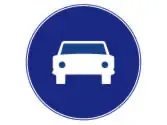
A la vista de la señal, ¿puede circular una motocicleta de dos ruedas sin sidecar?
Given the sign, may a two-wheeled motorcycle without a sidecar use this road?
- ASí, cualquier motocicleta.Yes, any motorcycle.
- BNo, solo automóviles, que no sean motocicletas de dos ruedas sin sidecar.No, only motor cars that are not two-wheeled motorcycles without a sidecar.
- CSí y, además, están obligadas a hacerlo.Yes, and in fact they are required to.
ExplanationThis is sign R-404: it requires drivers of motor cars, except two-wheeled motorcycles and similar three-wheeled vehicles, to use the carriageway at whose entrance it stands. It is an obligation, not a prohibition: the motorcycle is not required to use that carriageway, but it may use it.
Ante un STOP, la calzada tiene pintada una línea transversal continua. Si por nieve esa línea no es visible, ¿qué debes hacer?
At a STOP sign, a continuous transverse line is painted on the carriageway. If the line cannot be seen because of snow, what must you do?
- APuedo pasar sin detenerme, porque sin la marca vial la obligación desapareceI may go through without stopping, because without the road marking the obligation disappears
- BDetenerme igualmente, porque la señal vertical de STOP obliga con independencia de que se vea o no la marca vialStop anyway, because the STOP road sign requires you to stop whether or not the road marking can be seen
- CCeder el paso pero sin necesidad de detenerme por completoGive way, but without needing to stop completely
ExplanationThe R-2 road sign (STOP) requires you to stop completely; the road marking complements it, but its absence does not cancel the obligation.
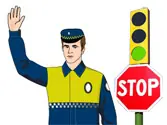
A la vista de esta imagen, ¿qué debe hacer el conductor del vehículo?
Looking at this picture, what must the driver of the vehicle do?
- ARespetar la señal del agente.Obey the traffic officer's signal.
- BPasar porque el semáforo le permite el paso con prioridad.Go through, because the traffic light gives them priority.
- CRespetar la señal de stop.Obey the STOP sign.
ExplanationSignals and instructions from traffic officers are always binding and must therefore be obeyed immediately by drivers and other road users. They prevail over any other sign and over the traffic rules, even if they contradict those rules and signs.
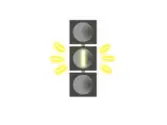
Esta línea blanca vertical intermitente en un carril reservado para autobuses y taxis, indica que ...
This flashing vertical white line in a lane reserved for buses and taxis indicates that...
- Apueden circular autobuses y taxis.buses and taxis may proceed.
- Bdeben detenerse todos los vehículos.all vehicles must stop.
- Cdeben detenerse autobuses y taxis.buses and taxis must stop.
ExplanationWhen, exceptionally, a traffic light consists of an illuminated white bar on a round black background, its signals apply only to trams and regular-service buses, unless there is a lane reserved for buses, or for buses, taxis and other vehicles; in that case, they apply only to the vehicles using that lane. These traffic lights mean the following: (1) an illuminated horizontal white bar prohibits passing in the same conditions as a steady red light; (2) an illuminated vertical white bar allows you to go straight on; (3) an illuminated white bar slanting to the left or to the right indicates that you may pass to turn left or right respectively; (4) a vertical or slanting white bar lit intermittently indicates that these vehicles must stop in the same conditions as for a steady amber light.
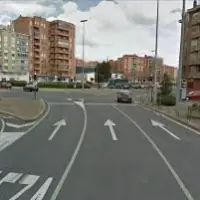
¿Qué indica una flecha situada en un carril delimitado por líneas longitudinales?
What does an arrow in a lane marked out by longitudinal lines indicate?
- AObligación de seguir la dirección contraria a la que muestra la flechaAn obligation to go in the opposite direction to the arrow
- BRecomendación de seguir la dirección de la flecha aunque no es obligatorioA recommendation to follow the arrow, although it is not compulsory
- CObligación de seguir la dirección de la flecha si no se cambia de carrilAn obligation to follow the arrow if you do not change lane
ExplanationAn arrow painted as a road marking in a lane marked out by longitudinal lines means that you must follow the direction it shows, as long as you stay in that lane and do not change lane.
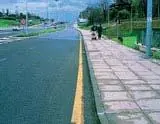
¿Puede una motocicleta realizar una parada o un estacionamiento junto a la línea longitudinal amarilla?
May a motorcycle stop or park next to the yellow longitudinal line?
- AEstacionar no, pero sí parar.It may not park, but it may stop.
- BNo, prohíbe parar y estacionar.No, the line prohibits stopping and parking.
- CParar no, pero sí estacionar.It may not stop, but it may park.
ExplanationA continuous yellow line along the kerb prohibits all vehicles, including motorcycles, from stopping and parking. If it were broken, it would only prohibit parking.
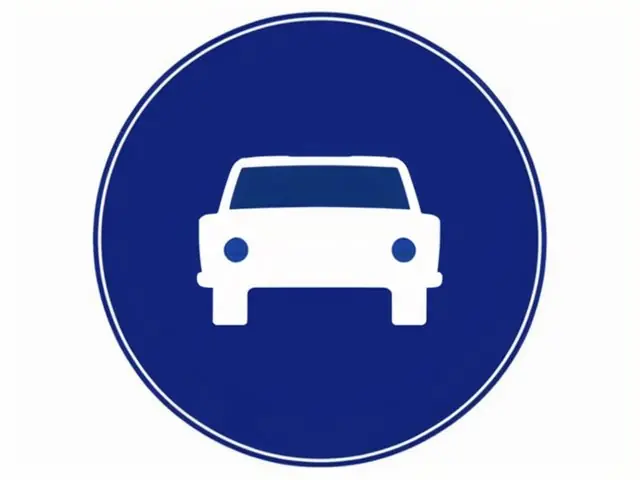
¿Puede circular cualquier vehículo por esta vía?
May any vehicle use this road?
- ASí.Yes.
- BNo. Es una vía solo para automóviles.No. It is a road for motor cars only.
- CSí, excepto motocicletas de dos ruedas.Yes, except two-wheeled motorcycles.
ExplanationSign R-404, compulsory carriageway for motor cars except two-wheeled motorcycles, requires those motor cars to use the carriageway at whose entrance it stands. Its definition does not prohibit other vehicles from using that carriageway.
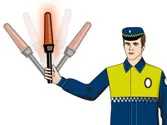
Un agente que balancea una luz amarilla, ¿qué indica?
What does a traffic officer swinging a yellow light indicate?
- AQue pueden continuar la marcha con precaución.That you may continue with care.
- BQue los usuarios deben moderar la velocidad.That road users must slow down.
- CObliga a detenerse a los usuarios de la vía a los que el agente dirige la luz.The road users towards whom the officer directs the light must stop.
ExplanationWhen an officer swings a yellow or red light, the road users towards whom the officer directs the light must stop. Do not confuse this with the officer moving an outstretched arm up and down, which requires drivers approaching on the side of the arm giving the signal, at right angles to that arm, to slow down.
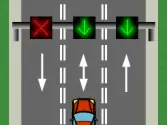
El vehículo rojo circula por el carril de la imagen y se encuentra una señal de Stop, ¿que deberá hacer?
The red vehicle is driving in the lane shown in the picture and finds a STOP sign. What must it do?
- AContinuar la marcha porque el semáforo en verde prevalecerá sobre la señal de Stop.Carry on, because the green traffic light will prevail over the STOP sign.
- BRespetar la señal de Stop y detenerse.Obey the STOP sign and stop.
- CModerar la velocidad y ceder el paso a los vehículos que se aproximen por la intersección.Slow down and give way to vehicles approaching at the junction.
ExplanationA green light in the shape of an arrow pointing downwards indicates that you may drive in the lane over which it is lit. This permission to use the lane does not remove the obligation to stop at a round red light or to obey any other sign or road marking that requires you to stop or give way, or, where there is none, to comply with the general rules on right of way.
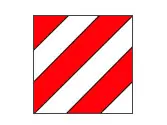
¿Cuándo se deberá señalizar la carga con la señal V-20?
When must a load be marked with sign V-20?
- ACuando salga por detrás de los vehículos.When it sticks out beyond the rear of the vehicle.
- BSolo cuando sea indivisible y salga por detrás, en los turismos.Only when it is indivisible and sticks out beyond the rear, on cars.
- CSolo en los camiones.Only on lorries.
ExplanationWhenever a load sticks out beyond the rear of a vehicle, except on vehicles less than one metre wide, it must be marked with sign V-20.
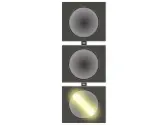
¿Qué significa este semáforo intermitente en un carril BUS?
What does this flashing traffic light in a BUS lane mean?
- AIndica detención para autobús, se debe actuar como si fuese una luz amarilla fija.It means stop for buses; you must act as if it were a steady amber light.
- BPermite el paso al autobús.It allows buses to go through.
- CPermite el paso al autobús, solo hacia la izquierda.It allows buses to go through, but only to the left.
ExplanationThe signals of this traffic light are only for trams and scheduled buses, unless there is a lane reserved for buses and other vehicles, in which case it refers only to those travelling in it, and it means stop in the same way as a steady amber light.
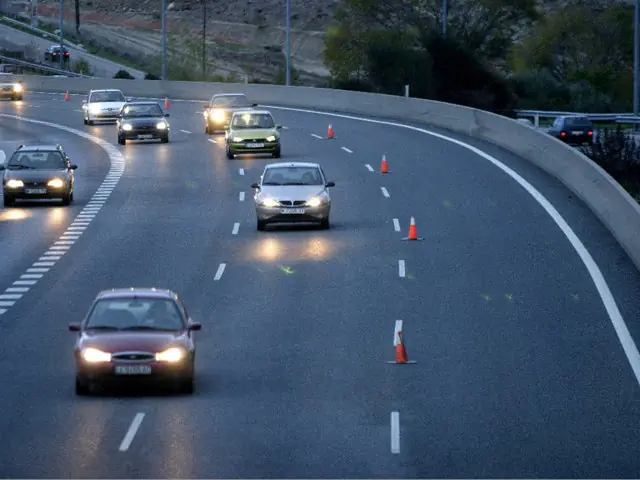
¿Puedes atravesar la línea de conos?
May you cross the line of cones?
- ASí. Porque están sobre una línea discontinua.Yes, because they are on a broken line.
- BSí, pero solo para adelantar.Yes, but only to overtake.
- CNo.No.
ExplanationCones separating lanes have the same value as a solid line: they must not be crossed, even if there is a broken line underneath. Temporary markers prevail over road markings, so you cannot cross them to overtake either.
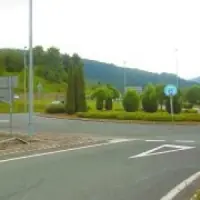
¿Qué indica un triangulo marcado sobre la calzada con la punta mirando al conductor?
What does a triangle marked on the carriageway with its point facing the driver indicate?
- AReducción de velocidadSpeed reduction
- BDetención obligatoriaCompulsory stop
- CCeda el pasoGive way
ExplanationThe give way road marking is a white triangle marked on the carriageway, with the corner opposite its short side pointing towards the approaching vehicle.
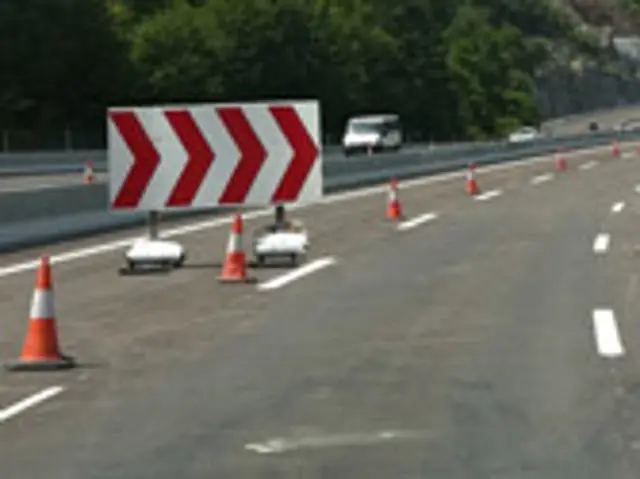
¿Qué indican estas señales de balizamiento?
What do these beacons indicate?
- AQue está prohibido circular por el carril izquierdo.That driving in the left-hand lane is prohibited.
- BQue hay un carril de salida a la derecha.That there is an exit lane on the right.
- CQue la próxima curva es especialmente peligrosa.That the next bend is especially dangerous.
ExplanationBeacons are used to guide traffic and warn of hazards. Here, the traffic cones and the sign show that the carriageway is restricted because of roadworks, so driving in the left-hand lane is prohibited. The RGC states that delineating devices prohibit entry to the part of the road they mark off, which is essential for the safety of drivers and of the people working on the site.
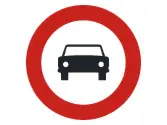
¿Podrá un turismo entrar en la vía así señalizada?
May a car enter the road marked like this?
- ASí, porque solo prohíbe a los vehículos de motor.Yes, because it only prohibits motor vehicles.
- BNo.No.
- CSí, si es un vehículo eléctrico.Yes, if it is an electric vehicle.
ExplanationThis is sign R-103 «No entry for motor vehicles, except two-wheeled motorcycles». A car is a motor vehicle, whether or not it is electric, so it may not enter; only two-wheeled motorcycles and three-wheeled vehicles treated as motorcycles are exempt.
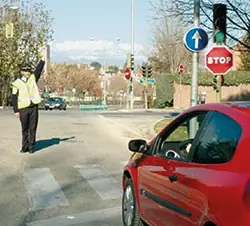
En una intersección señalizada en la que se encuentra un agente regulando el tráfico, ¿qué debe hacer?
At a junction with signs where a traffic officer is directing traffic, what must you do?
- AObedecer las señales del agente.Obey the traffic officer's signals.
- BObedecer las señales de tráfico que regulan la prioridad.Obey the road signs that regulate priority.
- CAplicar las normas generales de prioridad de paso de los vehículos que se acerquen por la derecha.Apply the general rules of right of way for vehicles approaching from the right.
ExplanationAccording to the order of priority in Article 133 of the General Traffic Regulations (RGC), traffic officers' signals prevail over all others: traffic lights, road signs, road markings and the general rules of priority. If a traffic officer is directing traffic, you obey the officer.
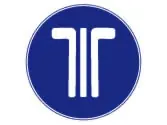
¿Qué vehículos podrán pasar a partir de la señal?
Which vehicles may go through after this sign?
- ASolo los que tengan un dispositivo de tele-peaje.Only those with an electronic toll device.
- BTodos los que tengan tele-peaje u otros medios de pago.All those with an electronic toll device or other means of payment.
- CSolo los taxis.Only taxis.
ExplanationThe sign shows that payment must be made with the electronic toll system; no other payment method can be used.
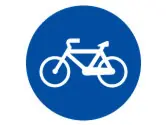
Esta señal indica que es una vía reservada para...
This sign indicates a route reserved for...
- Aciclos y ciclomotores.cycles and mopeds.
- Bsolo para ciclos.cycles only.
- Cciclos, ciclomotores y motocicletas.cycles, mopeds and motorcycles.
ExplanationThe sign indicates a route reserved for cycles, which other road users are prohibited from using.
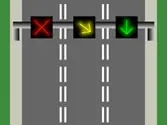
Si circula por el carril central, ¿Qué debe hacer a la vista del semáforo de carril?
If you are driving in the centre lane, what should you do given the lane signal?
- ACambiarme lo antes posible al carril de la derecha.Move to the right-hand lane as soon as possible.
- BSeguir circulando por él, extremando la precaución.Keep driving in it, taking extra care.
- CEl carril central solo se puede utilizar para adelantar.The centre lane may only be used for overtaking.
ExplanationWhen a lane signal shows a diagonal yellow arrow, it tells you to move to the side the arrow points to, because this lane will soon end in your direction.
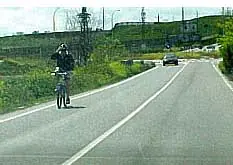
¿Podría el vehículo que observamos en la fotografía adelantar al ciclista que le precede según la señalización existente?
According to the existing signs and markings, could the vehicle in the photograph overtake the cyclist in front of it?
- ASí, pero sin atravesar la línea continua.Yes, but without crossing the continuous line.
- BNo.No.
- CSí, atravesando la línea del centro de la calzada y dejando como mínimo 1,50 m. de separación, cuando no circulen vehículos en sentido contrario.Yes, crossing the line in the centre of the carriageway and leaving a gap of at least 1.50 m, when there are no vehicles coming the other way.
ExplanationYou may overtake a cyclist even where overtaking is prohibited, moving onto the opposite side of the road if nobody is coming and it can be done without risk. You must leave a gap of at least 1.5 metres and, from 1 October 2026, outside built-up areas you must reduce your speed by at least 20 km/h.
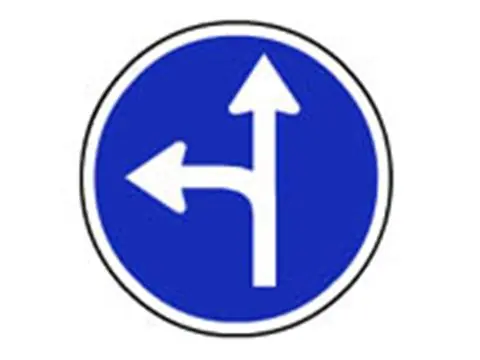
En una intersección regulada con esta señal, ¿está permitido girar a la derecha?
At a junction controlled by this sign, may you turn right?
- ASí, es la única dirección permitida.Yes, it is the only direction allowed.
- BSí, aunque también se puede girar a la izquierda o seguir de frente.Yes, although you may also turn left or go straight on.
- CNo, es obligatorio girar a la izquierda o seguir de frente.No, you must turn left or go straight on.
ExplanationThis mandatory sign only allows you to turn left or go straight on at the junction. Turning right and making a U-turn are prohibited.
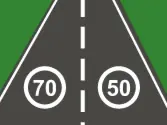
La señal de limitación de velocidad afecta a los vehículos que circulen por...
The speed limit sign applies to vehicles travelling...
- Ael lado de la vía sobre el que está situada.on the side of the road where it is placed.
- Btoda la calzada.on the whole carriageway.
- Cel carril sobre el que está situada.in the lane where it is placed.
ExplanationIf the figure is placed in a lane bounded by longitudinal lines, solid or broken, the prohibition applies only to vehicles travelling in that lane.
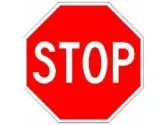
Si una vez efectuada la detención ante la línea de detención no disponemos de suficiente visibilidad, ¿cómo actuaremos?
If, after stopping at the stop line, you do not have enough visibility, what should you do?
- AAtravesaremos la intersección extremando las precauciones.Cross the junction, taking extra care.
- BAvanzaremos lentamente para volver a detenernos donde tengamos suficiente visibilidad.Move forward slowly and stop again where you have enough visibility.
- CUna vez efectuada la detención ante la línea ya podremos pasar al haber cumplido la obligación de detenernos.Once you have stopped at the line you may go, because you have met the obligation to stop.
ExplanationIf, after stopping at the transverse line, you do not have visibility, you must move forward and stop again where there is enough visibility, so you make two stops.
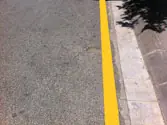
¿Qué indica una línea longitudinal continua amarilla junto al borde de la calzada?
What does a continuous yellow longitudinal line along the edge of the carriageway indicate?
- AProhíbe parar y estacionar.No stopping and no parking.
- BProhíbe estacionar pero no parar.No parking, but stopping is allowed.
- CProhíbe detenerse.No halting.
ExplanationA continuous longitudinal line along the edge of the carriageway means that stopping and parking are prohibited or subject to a time restriction.
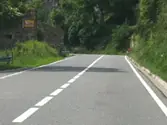
Cuando la separación entre los trazos de una línea discontinua es sensiblemente más corta de lo habitual, ¿qué podrá indicar?
When the gaps between the dashes of a broken line are noticeably shorter than usual, what may this indicate?
- AQue debemos moderar la velocidad.That we must slow down.
- BQue no se podrá atravesar dicha línea.That the line may not be crossed.
- CLa proximidad de una línea continua.That a solid line is close.
ExplanationWhen the distance between the dashes of a broken line is noticeably shorter than normal, it may announce that the driver is approaching a solid line or a particularly dangerous stretch.
¿Se puede cruzar la línea central continua?
Can you cross the solid centre line?
- ASí, para cambiar de dirección.Yes, to turn.
- BNo.No.
- CSí, si se trata de una calzada de un solo sentido.Yes, if the carriageway is one-way.
ExplanationUnder the road-marking catalogue in Annex I of the RGC, no driver may cross a solid longitudinal line or drive on it. Not even to turn: the solid line is only interrupted by a broken line where turning into an access road is allowed.
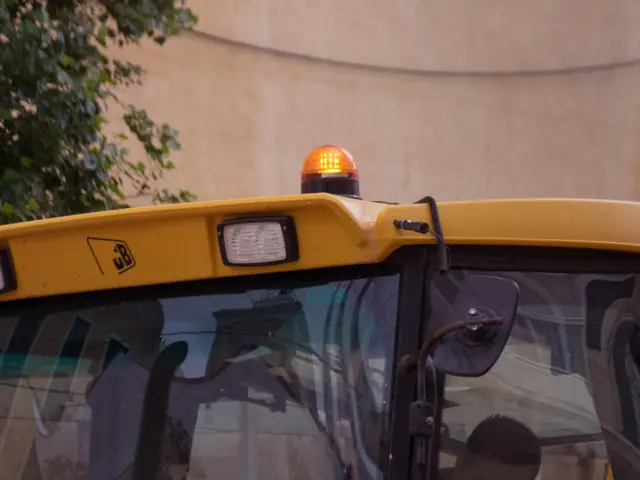
Un vehículo especial circula por una vía pública a menos de 40 kilómetros por hora. ¿Cuándo debe utilizar la señal de luz V-2?
A special vehicle is travelling on a public road at less than 40 kilometres per hour. When must it use the V-2 light signal?
- ASiempre, de día y de noche.Always, by day and by night.
- BSolo cuando realiza tareas para limpiar o reparar la vía.Only when it is cleaning or repairing the road.
- CSolo cuando circula entre la puesta del sol y la salida del sol.Only when travelling between sunset and sunrise.
ExplanationSpecial vehicles travelling at less than 40 km/h must make their presence known with the V-2 light signal, a rotating or flashing yellow light, by day and by night. Their low speed is a danger to other traffic, which must be able to spot them in advance.
Si al llegar a un paso a nivel con barreras nos encontramos con un semáforo con luz roja intermitente, ¿qué haremos?
If, on reaching a level crossing with barriers, you find a traffic light with a flashing red light, what should you do?
- APasa extremando la precaución.Go through, taking extra care.
- BDetenernos.Stop.
- CPasar rápidamente por estar próxima la bajada de la barrera.Go through quickly, because the barrier is about to come down.
ExplanationA traffic light with a flashing red light, or with two alternately flashing red lights, before a level crossing prohibits vehicles from passing.
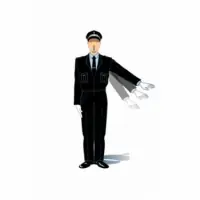
Un agente le hace señales moviendo el brazo alternativamente de arriba abajo. ¿Qué debe hacer?
An officer signals to you by moving their arm alternately up and down. What must you do?
- ADetenerse inmediatamente a la derecha.Stop immediately on the right.
- BDisminuir la velocidad.Slow down.
- CGirar hacia el lado que indica el brazo.Turn towards the side the arm indicates.
ExplanationAn officer holding their arm out and moving it up and down requires drivers approaching on the side of the arm giving the signal to slow down. To stop traffic, officers use a raised arm or arms held out.
¿Está obligado a circular cualquier automóvil por una calzada así señalizada?
Must every motor car use a carriageway marked with this sign?
- ASí, porque es una vía exclusiva para automóviles.Yes, because it is a road only for motor cars.
- BSí, excepto camiones y furgones.Yes, except lorries and box lorries.
- CSí, excepto las motocicletas de dos ruedas.Yes, except two-wheeled motorcycles.
ExplanationThis is sign R-404 «Compulsory carriageway for motor cars, except two-wheeled motorcycles»: it requires drivers of motor cars to use that carriageway, except two-wheeled motorcycles and three-wheeled vehicles treated as motorcycles.
Una luz roja en forma de aspa en un semáforo de carril, ¿qué indica a los conductores de vehículos que circulan por el carril sobre el que está situado?
What does a red X-shaped light on a lane-control traffic light tell drivers of vehicles in the lane it is placed over?
- AQue deben detenerse a la altura del semáforo.That they must stop level with the traffic light.
- BQue está prohibido ocupar dicho carril y deben abandonarlo lo antes posible.That they must not use that lane and must leave it as soon as possible.
- CQue deben detenerse al llegar a un puesto de aduana, de policía, de peaje u otro.That they must stop when they reach a customs, police, toll or other checkpoint.
ExplanationUnder Annex I of the General Traffic Regulations (RGC), a red X-shaped light on a lane-control traffic light prohibits using that lane, and those driving in it must leave it as quickly as possible. It does not require you to stop level with the traffic light.
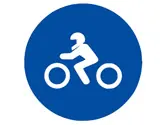
¿Un ciclomotor podrá circular por la calzada así señalizada?
Can a moped use a carriageway marked like this?
- ANo, por ser una calzada exclusiva para motocicletas.No, because this carriageway is only for motorcycles.
- BSí, los ciclomotores también podrán usar esta calzada.Yes, mopeds may also use this carriageway.
- CSí, pero solo si circulan a más de 40 km/h.Yes, but only if they travel at more than 40 km/h.
ExplanationThe sign in the question requires motorcycle riders to use the carriageway at whose entrance it is placed, but it does not prohibit drivers of other types of vehicle from using it.
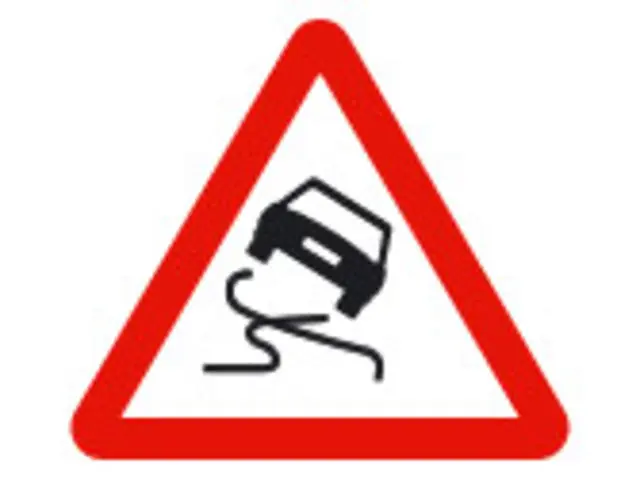
¿Qué indica la señal que aparece en la imagen?
What does the sign in the picture indicate?
- AProyección de gravillaLoose chippings.
- BPavimento resbaladizoSlippery road surface.
- CPavimento resbaladizo por hielo o nieveRoad surface slippery due to ice or snow.
ExplanationThe sign in the picture, with a skidding car and zigzag tracks, warns of a stretch ahead where the road surface may be slippery, without specifying the cause. A road surface slippery due to ice or snow has its own sign, with a snowflake.
Los que empujen o arrastren un ciclo, ciclomotor de dos ruedas o vehículo de movilidad personal deberán cumplir las órdenes de los agentes y las señales de tráfico que se encuentren a su paso y circularán...
People pushing or pulling a cycle, a two-wheeled moped or a personal mobility vehicle must obey traffic officers' orders and the traffic signs they come across, and must travel...
- APor su derecha.On the right.
- BPor su izquierda.On the left.
- CIndistintamente por su izquierda o por su derecha.On either the left or the right.
ExplanationUnder Article 122.2 of the RGC (as worded by RD 518/2026), people pushing or pulling a cycle, a two-wheeled moped or a personal mobility vehicle must always keep to the right and obey traffic officers' orders and the traffic signs they come across.
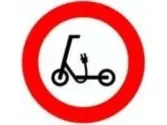
Al encontrarse con esta señal, un usuario de patinete eléctrico debe:
On seeing this sign, an e-scooter rider must:
- AExtremar la precaución, pero puede circular igualmente.take extra care, but may still ride on.
- BDetenerse y no acceder a la vía señalizada.stop and not enter the road with the sign.
- CContinuar por la acera, cediendo el paso a los peatones.continue on the pavement, giving way to pedestrians.
ExplanationThe sign prohibits personal mobility vehicles from entering, so a PMV rider may not enter the road with this sign or ride on the pavement.
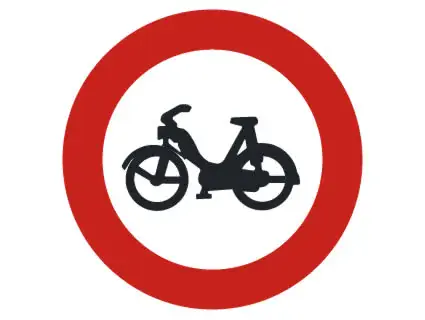
Si Vd. conduce un ciclomotor de tres ruedas, ¿podrá entrar en una vía indicada con esta señal?
If you are riding a three-wheeled moped, may you enter a road marked with this sign?
- ASí.Yes.
- BNo.No.
- CSí, porque la señal solo afecta a los de dos ruedas.Yes, because the sign only applies to two-wheeled mopeds.
ExplanationThe sign in the picture is R-105 “No entry for mopeds”, which prohibits access to all mopeds, whether they have two or three wheels, and also to vehicles for people with reduced mobility.
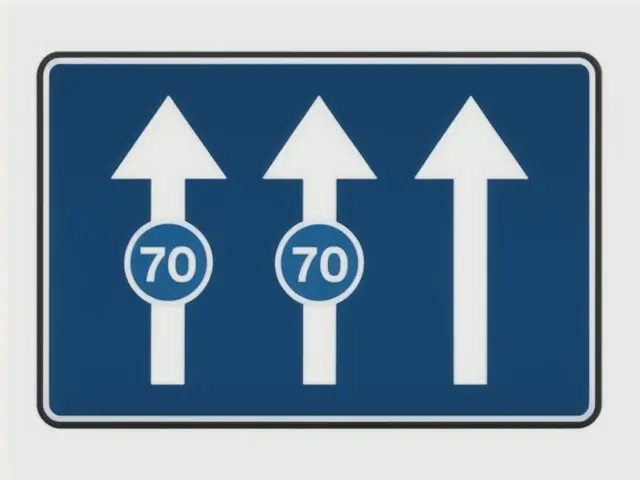
Esta señal indica que los carriles señalizados con velocidad mínima...
This sign indicates that lanes marked with a minimum speed...
- Asólo se pueden usar si circula a una velocidad inferior a la indicada.may only be used if you are driving below the speed shown.
- Bestán destinados a vehículos rápidos y el carril más a la derecha es para vehículos lentos.are for fast vehicles, and the right-hand lane is for slow vehicles.
- Csólo se pueden usar si circula a una velocidad igual o superior a la indicada.may only be used if you are driving at or above the speed shown.
ExplanationIn S-50 lane signs, a number in a blue circle is a minimum speed: only vehicles travelling at that speed or faster may use those lanes, here 70 km/h. Slower vehicles use the lane with no number, and outside built-up areas you normally drive in the right-hand lane.
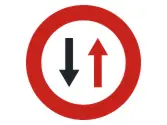
Esta señal colocada a la entrada del estrechamiento, ¿obliga a detenerse?
Does this sign, placed at the entrance to the narrowing, require you to stop?
- ASí, en todo caso.Yes, in all cases.
- BNo, la señal nos da prioridad respecto al sentido contrario.No, the sign gives us priority over the opposite direction.
- CNo.No.
ExplanationThis sign prohibits entry into a narrow passage until it is possible to get through it without forcing vehicles travelling in the opposite direction to stop. When that situation does not arise, it is not compulsory to stop.
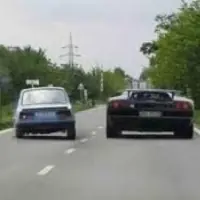
¿Puede un vehículo circular sobre la línea discontinua de una vía?
Can a vehicle drive on the broken line of a road?
- ANo, en ningún casoNo, never
- BSí, pero únicamente cuando sea imprescindible hacerloYes, but only when it is essential
- CSi, puede recorrer varios kilómetros pisándolaYes, it may drive along it for several kilometres
ExplanationVehicles on a road may drive on its broken line, but only when it is essential, for example to change lanes. As a general rule you should not drive on it, and driving on a solid line is completely prohibited.
En un turismo, ¿Es correcto llevar en brazos a un bebé?
In a car, is it correct to carry a baby in your arms?
- ASolamente si se ocupa uno de los asientos traseros y el conductor circula a baja velocidad.Only if you are in one of the rear seats and the driver is driving slowly.
- BSí, como medida de protección.Yes, as a protective measure.
- CNo, debe ir sentado en un dispositivo de seguridad debidamente homologado.No, the baby must sit in a properly approved safety device.
ExplanationA baby must never travel in someone's arms: in a crash its weight is multiplied and it is impossible to hold, and the adult may also crush it. Children 135 cm tall or less must use an approved child restraint system (child seat) suited to their height and weight.
En una vía con semáforos o señales a ambos lados que dan indicaciones distintas, solo deben obedecer las situadas a su izquierda quienes quieran...
On a road with traffic lights or signs on both sides that give different instructions, only those on the left must be obeyed by drivers who want to...
- Aseguir de frente o girar a la derecha.go straight on or turn right.
- Bgirar a la izquierda solamente.turn left only.
- Cgirar a la izquierda o seguir de frente.turn left or go straight on.
ExplanationAccording to Article 132.3 of the General Traffic Regulations, if the traffic lights or road signs on the right and on the left give different instructions, drivers who are going to turn left or go straight on must obey only those on their left.
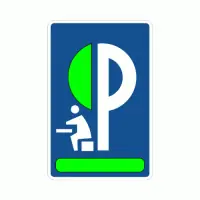
Esta señal indica la situación de un...
This sign shows the location of a...
- Amerendero fuera de la vía de servicio.picnic area off the service road.
- Balbergue de juventud.youth hostel.
- Cárea de descanso.rest area.
ExplanationSign S-123 shows the location of a rest area. It should not be confused with the youth hostel sign (S-117) or the picnic area sign (S-114), which have other symbols.
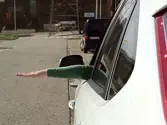
El conductor del vehículo de la fotografía está indicando que va a...
The driver of the vehicle in the photograph is indicating that they are going to...
- Adesplazarse hacia la izquierda.move to the left.
- Bdesplazarse hacia la derecha.move to the right.
- Cfrenar.brake.
ExplanationWith the arm held horizontally and the palm of the hand stretched out facing downwards, the driver indicates that they are going to move to the left.
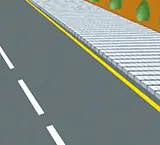
¿Qué indica la línea longitudinal amarilla?
What does the yellow longitudinal line indicate?
- AQue se puede parar pero no estacionar.That you may stop but not park.
- BQue no se puede parar ni estacionar.That you may neither stop nor park.
- CQue se puede parar y estacionar.That you may stop and park.
ExplanationA solid yellow longitudinal marking next to the edge of the carriageway prohibits both stopping and parking along the whole stretch it covers, because stopping there would obstruct traffic.
¿Ante una señal de STOP, debemos detenernos?
At a STOP sign, must you stop?
- ASí, siempre cediendo el paso.Yes, always, and give way.
- BSí, cuando no haya visibilidad.Yes, when there is no visibility.
- CSí, cuando no haya peatones.Yes, when there are no pedestrians.
ExplanationA STOP sign requires every driver to stop their vehicle at the next stop line or, if there is none, immediately before the junction, and to give way there to vehicles on the road they are approaching.
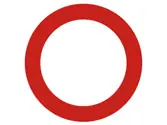
A partir del lugar en que está situada esta señal...
From the place where this sign stands...
- ASe prohíbe la circulación a toda clase de vehículos en ambos sentidos.all vehicles are prohibited in both directions.
- BSe prohíbe la circulación a toda clase de vehículos solo en el sentido que encontramos la señal.all vehicles are prohibited only in the direction in which we find the sign.
- CSe prohíbe la circulación solamente a los vehículos de motor.only motor vehicles are prohibited.
ExplanationThis sign prohibits all vehicles, including bicycles, in both directions.
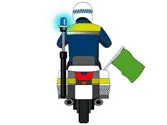
¿Qué le indica un agente que circula en una motocicleta portando una bandera verde?
What does a traffic officer riding a motorcycle and carrying a green flag tell you?
- AQue tenemos que circular extremando la precaución.That we must drive taking extreme care.
- BQue la calzada está abierta al tráfico a partir de su paso.That the carriageway is open to traffic once they have passed.
- CQue se está realizando una prueba deportiva.That a sporting event is taking place.
ExplanationA traffic officer with a green flag shows that the carriageway is open to traffic again after another officer with a red flag has passed.
All topics
- Definitions
- Documents and penalty points
- The driver's condition
- Duties of drivers and pedestrians
- Vehicle safety devices
- Vehicle controls and equipment
- Vehicle lights and horn
- The road and its lanes
- Speed and distances
- Manoeuvres
- Right of way
- Carrying passengers and loads
- Driving safely in difficult conditions
- Vehicle mechanics and maintenance
- Road accidents and first aid
- Defensive and eco-driving
Independent app: not affiliated with or endorsed by the DGT (Spain's Directorate-General for Traffic) or the Ministry of the Interior. The official exam is booked with the DGT and taken at its test centres. The questions here are practice material; the DGT's official question bank is not public.
Basado en datos de la Agencia Estatal Boletín Oficial del Estado (https://www.boe.es). Textos consolidados de carácter meramente informativo. La AEBOE no patrocina ni respalda este sitio.
Parte de las preguntas procede de los tests de la revista «Tráfico y Seguridad Vial» de la DGT, reproducidos con indicación de la fuente.